
Walk down any supplement aisle and you’ll see products labeled probiotic, prebiotic, and postbiotic — sometimes all on the same shelf, sometimes even in the same bottle. The terms sound similar, but they refer to genuinely different things that play distinct roles in gut health. This guide breaks down probiotics vs prebiotics vs postbiotics: what each one actually is, how they work together, and how to think about getting them from food versus supplements.
The Short Version
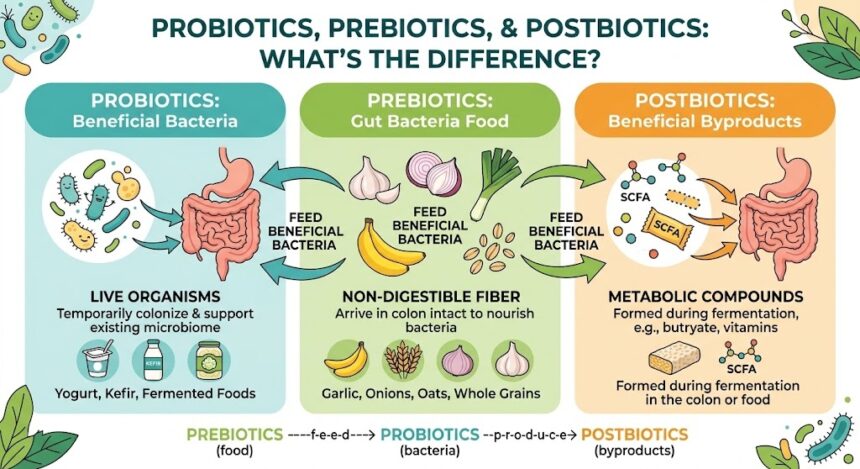
Here’s the relationship in one sentence: prebiotics are food for your gut bacteria, probiotics are the beneficial bacteria themselves, and postbiotics are the beneficial byproducts those bacteria produce after eating prebiotics. They function as a continuum — prebiotics feed probiotics, which in turn generate postbiotics — rather than three interchangeable options you pick from.
What Are Probiotics?
Probiotics are live microorganisms — mainly bacteria, along with some yeasts — that provide a health benefit when consumed in adequate amounts. They’re the only one of the three that are living organisms.
Once consumed, probiotics need to survive digestion and reach the colon, where they can temporarily add to and support your existing gut microbiome. Different strains have been studied for different purposes: some are more associated with digestive comfort and regularity, others with immune support, and research into strain-specific effects is ongoing.
Common food sources: yogurt with live cultures, kefir, sauerkraut, kimchi, miso, tempeh, and other fermented foods that still contain active bacteria at the time you eat them.
A practical note: not all fermented foods contain live probiotics by the time they reach you. Some, like most bread and beer, are fermented but then heated or processed in ways that kill the live bacteria. Read labels for phrases like “live and active cultures” if getting probiotics from food is your goal.
What Are Prebiotics?
Prebiotics are non-digestible fibers and compounds that serve as food for the beneficial bacteria already living in your gut. Unlike probiotics, prebiotics aren’t living organisms — they’re a type of dietary fiber that resists digestion in your stomach and small intestine, arriving largely intact in your colon, where gut bacteria ferment them.
This fermentation process is what feeds and supports the growth of beneficial bacteria, helping your existing microbiome flourish rather than introducing new organisms from outside.
Common food sources: garlic, onions, leeks, asparagus, bananas (especially slightly underripe ones), oats, legumes, and whole grains. Chicory root and Jerusalem artichoke are particularly concentrated sources often used in supplements.
There’s no official recommended daily intake, but some research suggests that consuming several grams of prebiotic fiber daily is enough to meaningfully stimulate beneficial gut bacteria. Most people get some prebiotics through a normal high-fiber diet without needing to track it precisely.
What Are Postbiotics?
Postbiotics are the newest of the three terms to enter mainstream conversation, and they’re often the most misunderstood. Postbiotics are the beneficial compounds produced when probiotic bacteria ferment and consume prebiotics — including short-chain fatty acids (like butyrate), certain vitamins (B and K), amino acids, and antimicrobial peptides.
Some postbiotic supplements also use inactivated (dead) bacteria and the compounds they leave behind, which is different from a live probiotic supplement. Because postbiotics don’t involve living organisms, they tend to be more shelf-stable and, for people with compromised immune systems, may carry lower risk than introducing live bacteria.
Common food sources: postbiotics naturally form during the fermentation of foods like sauerkraut, tempeh, and other fermented products, though the fermentation process itself (not just eating the food) is what generates them. They’re also produced internally, in your colon, whenever your existing gut bacteria ferment prebiotic fiber you eat.
Research on postbiotics is newer and less extensive than research on probiotics, though early findings point to potential anti-inflammatory and antioxidant properties. This is an active area of ongoing study rather than a settled science.
How They Work Together
Thinking of these as three separate products to shop for misses the bigger picture. In a well-functioning gut, the process looks like this:
- You eat prebiotic fiber (from foods like garlic, oats, or bananas)
- Probiotic bacteria already living in your colon — or ones you’ve consumed through fermented foods — ferment that fiber
- This fermentation produces postbiotics, the beneficial compounds that support gut lining health, reduce inflammation, and help regulate the immune system
This is why prebiotic-rich foods are sometimes described as more foundational than probiotic supplements alone — without prebiotics to feed them, probiotic bacteria (whether from food or supplements) have less to work with once they reach your gut.
Food vs. Supplements: Which Should You Choose?
For most healthy people without a specific diagnosed condition, getting probiotics, prebiotics, and postbiotics through whole foods is a reasonable default. Fermented foods provide live probiotic cultures, fiber-rich plant foods provide prebiotics, and the fermentation and digestion process generates postbiotics naturally as a result.
Supplements can be useful in specific situations — for example, certain probiotic strains have research support for use alongside antibiotics, or for specific digestive conditions under a doctor’s guidance. But probiotic supplements are not one-size-fits-all: effects are often strain-specific, and a product that helped one person’s digestive symptoms may do nothing for someone else’s. If you’re considering a probiotic supplement for a specific health concern, it’s worth discussing strain selection with a healthcare provider or dietitian rather than choosing based on marketing claims alone.
Practical Ways to Get All Three From Food
- Combine prebiotic and probiotic foods in the same meal: top yogurt with sliced banana and oats, or add sauerkraut alongside a meal with whole grains.
- Build fiber diversity gradually: a wide variety of plant fibers supports a wider range of beneficial bacteria than relying on one or two prebiotic sources.
- Check labels on fermented products: look for “contains live and active cultures” if probiotic content is the goal, since pasteurization after fermentation kills live bacteria.
- Don’t overhaul your diet overnight: a sudden jump in fiber and fermented foods can cause temporary bloating or gas. Increasing gradually gives your gut time to adjust.
For a broader list of gut-supportive foods across all three categories, see our guide to best foods for gut health.
When to Talk to a Doctor Before Supplementing
Consider checking with a healthcare provider before starting probiotic, prebiotic, or postbiotic supplements if you:
- Have a compromised or suppressed immune system
- Have recently had surgery or a serious illness
- Are managing a diagnosed digestive condition like IBS or SIBO, since some probiotics may not be appropriate depending on the condition
- Experience new or worsening digestive symptoms after starting a supplement
Frequently Asked Questions
Can I take probiotics and prebiotics together?
Yes, and doing so is often more effective than either alone, since prebiotics give probiotic bacteria something to feed on once they reach your gut. Products that combine both are sometimes marketed as “synbiotics.”
Which is more important: probiotics, prebiotics, or postbiotics?
None is inherently more important — they work as a system. That said, prebiotic fiber is arguably the most foundational, since it supports the beneficial bacteria you already have, whether or not you’re also consuming probiotics.
Do postbiotic supplements actually work?
Research on postbiotic supplements is newer and less extensive than research on probiotics. Early findings are promising for specific applications, but the evidence base is still developing, so it’s reasonable to treat marketing claims with some skepticism.
Can I get enough of all three from diet alone?
For most healthy people, yes. A varied diet with fermented foods and fiber-rich plants can supply meaningful amounts of all three without needing supplements.
Are probiotics safe for everyone?
Probiotics are generally safe for healthy people, but caution is warranted for those with compromised immune systems, recent surgery, or serious illness, since introducing live organisms carries some risk in those situations. Postbiotics may be a lower-risk alternative in these cases since they don’t involve live bacteria.
Final Thoughts
Probiotics, prebiotics, and postbiotics aren’t competing products — they’re three connected parts of the same gut health system. Rather than picking one to focus on, the most practical approach for most people is building a diet that naturally includes all three: fermented foods for live bacteria, fiber-rich plants to feed them, and the beneficial compounds that result from that process happening consistently over time.