Final Click SolutionFinal Click SolutionFinal Click Solution
  • Home
  • Health
    • Digestive Health
    • Nutrition & Diet
    • Skin & Body Care
  • Contact Us
  • About Us
Reading: IBS vs SIBO: Key Differences, Overlap, and How to Tell Them Apart
Share
Sign In
Notification
Font ResizerAa
Final Click SolutionFinal Click Solution
Font ResizerAa
Search
  • Home
  • Health
  • Contact Us
Have an existing account? Sign In
© 2026 Final Click Solution. Practical health tips and wellness guides for everyday life.
Final Click Solution > Health > Digestive Health > IBS vs SIBO: Key Differences, Overlap, and How to Tell Them Apart
Digestive Health

IBS vs SIBO: Key Differences, Overlap, and How to Tell Them Apart

Muhammad Bilal Azam
Last updated: August 18, 2026 6:18 am
Muhammad Bilal Azam
Share
15 Min Read
IBS vs SIBO: Key Differences, Overlap, and How to Tell Them Apart
SHARE

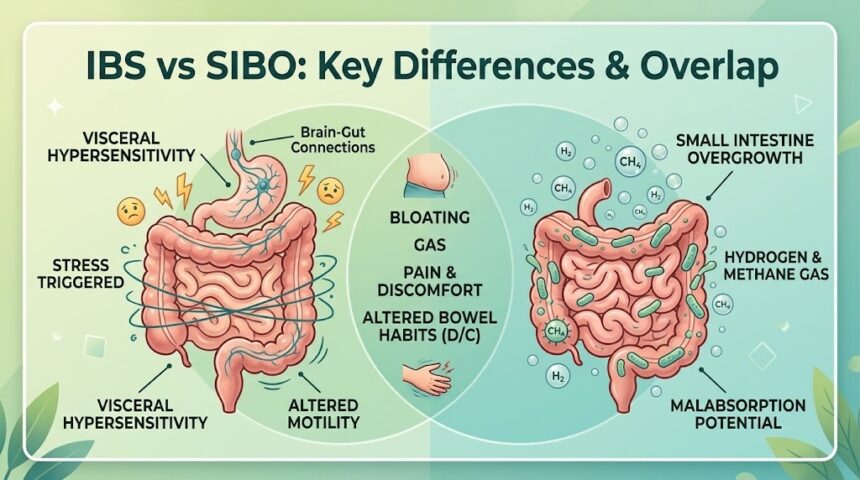
IBS vs SIBO is a common source of confusion because the two conditions share nearly identical symptoms — bloating, gas, abdominal pain, and irregular bowel habits — but they’re diagnosed and treated differently. Understanding the distinction matters because a treatment plan built for one doesn’t reliably work for the other, and some people actually have both at the same time.

Contents
IBS and SIBO at a GlanceWhat Is IBS?What Is SIBO?Symptom Overlap: Why They’re Often ConfusedKey Differences Between IBS and SIBOCan You Have Both IBS and SIBO?How Each Is DiagnosedIBS diagnosisSIBO diagnosisTreatment DifferencesIBS treatment approachSIBO treatment approachDiet Differences: Low-FODMAP vs SIBO-Specific DietsRisk Factors: What Makes SIBO More LikelyMethane vs Hydrogen SIBO: Why the Type MattersWhy Getting the Right Label MattersWhen to See a DoctorLiving With IBS, SIBO, or Both: Practical Day-to-Day TipsFrequently Asked QuestionsIs SIBO a type of IBS?Which is more common, IBS or SIBO?Can treating SIBO cure my IBS?Do IBS and SIBO require different breath tests?Should I ask for a SIBO test if I already have an IBS diagnosis?Related reading

This guide breaks down what each condition is, where the symptoms overlap, how they’re diagnosed, and how treatment and diet approaches differ — so you know which questions to bring to your next doctor’s appointment instead of guessing between the two based on symptoms alone.

IBS and SIBO at a Glance

  • IBS (irritable bowel syndrome) is a functional gut disorder — the bowel is more sensitive and its muscle timing is off, but standard tests generally look normal.
  • SIBO (small intestinal bacterial overgrowth) is a specific, testable condition where bacteria that normally live mostly in the colon overgrow in the small intestine, where far fewer bacteria are supposed to be.
  • SIBO can exist as its own condition or as an underlying cause behind some cases of IBS, particularly IBS-D.

What Is IBS?

IBS is diagnosed based on a pattern of symptoms — recurring abdominal pain linked to bowel habit changes — after other conditions have been ruled out. There’s no single blood test or scan that confirms IBS; the diagnosis relies on symptom criteria (often Rome criteria) plus normal results on standard testing. For a full breakdown of symptoms and subtypes, see our guide on IBS symptoms, triggers, and relief tips.

What Is SIBO?

SIBO happens when bacteria overgrow in the small intestine, where they ferment carbohydrates too early in the digestive process. That fermentation produces excess gas — hydrogen, methane, or both — leading to bloating, discomfort, and altered bowel habits. Unlike IBS, SIBO has an objective test: a breath test that measures hydrogen and methane after drinking a sugar solution. For more detail, see our full guide on SIBO symptoms, causes, and treatment.

Symptom Overlap: Why They’re Often Confused

Both conditions commonly involve:

  • Bloating, especially worsening through the day
  • Excess gas
  • Abdominal pain or cramping
  • Diarrhea, constipation, or a mix of both
  • Symptoms that seem tied to specific foods

Because the symptom lists look almost identical on paper, it’s genuinely difficult to tell them apart by symptoms alone — which is exactly why testing matters, and why some people are treated for IBS for years before SIBO is identified as an underlying driver. A few subtle clues can hint at SIBO specifically: bloating that appears fast, often within 30–90 minutes of eating rather than building gradually through the day, and a stronger, more predictable link to specific fermentable carbohydrates rather than a broad mix of stress, food, and hormonal triggers.

Key Differences Between IBS and SIBO

FeatureIBSSIBO
Nature of the conditionFunctional — gut sensitivity and motility issueStructural/microbial — bacterial overgrowth in the small intestine
Diagnostic testNo specific test; symptom-based criteria after ruling out other causesBreath test measuring hydrogen/methane gas
Underlying causeGut-brain axis dysfunction, prior infection, stress, geneticsBacteria overgrowing where they shouldn’t be, often due to slow motility, structural issues, or prior infection
Bloating patternVariable, often worsens with stress or trigger foodsOften worsens specifically and predictably after eating fermentable carbs
Response to antibioticsNot a standard treatmentOften a first-line treatment (e.g., rifaximin)

Can You Have Both IBS and SIBO?

Yes. Research suggests a meaningful subset of people diagnosed with IBS, particularly IBS-D, test positive for SIBO when specifically tested. In these cases, SIBO may be an underlying contributor to IBS-like symptoms rather than a separate, unrelated condition. This is part of why symptoms that don’t fully respond to standard IBS management — like a low-FODMAP diet and stress care — sometimes warrant a SIBO breath test as a next step. It also explains why some people notice real, though incomplete, relief from IBS-focused strategies: those strategies may be managing part of the picture (gut sensitivity, motility, stress response) while leaving an underlying bacterial overgrowth untreated.

How Each Is Diagnosed

IBS diagnosis

A doctor typically reviews your symptom pattern against diagnostic criteria, asks about red-flag symptoms (unexplained weight loss, blood in stool, fever, anemia, symptoms starting after age 50), and may order blood work, stool tests, or a colonoscopy to rule out other conditions like IBD or celiac disease. IBS is essentially a diagnosis reached after other explanations are excluded.

SIBO diagnosis

SIBO is diagnosed with a breath test: you drink a glucose or lactulose solution, then breathe into a collection device at set intervals over a few hours. Elevated hydrogen or methane levels early in the test suggest bacterial overgrowth in the small intestine rather than normal fermentation happening later in the colon.

Treatment Differences

IBS treatment approach

  • Dietary changes, often including a supervised low-FODMAP trial
  • Stress management and gut-directed therapies like CBT
  • Fiber adjustments suited to the IBS subtype
  • Medications targeted at the dominant symptom (antispasmodics, loperamide for IBS-D, osmotic laxatives for IBS-C)

SIBO treatment approach

  • Antibiotics such as rifaximin, sometimes combined with a second antibiotic for methane-predominant SIBO
  • Addressing the underlying cause where possible — such as motility issues or structural abnormalities — to reduce recurrence
  • A temporary low-fermentation diet during and shortly after treatment, then broadening the diet again
  • Retesting after treatment to confirm the overgrowth has cleared

Diet Differences: Low-FODMAP vs SIBO-Specific Diets

A low-FODMAP diet is the standard dietary approach for IBS — it reduces fermentable carbohydrates broadly to calm symptoms, then reintroduces them to map personal triggers. SIBO-specific diets (such as a low-fermentation or SIBO-specific food plan) work on a similar principle but are typically used short-term, alongside antibiotic treatment, rather than as a long-term management tool. Neither diet is meant to be permanent; both are diagnostic or supportive tools used for a defined period, then loosened based on what’s actually confirmed as a trigger.

Risk Factors: What Makes SIBO More Likely

SIBO doesn’t happen randomly — it usually has a mechanical or motility reason behind it. Common contributors include:

  • Slow gut motility — when the small intestine’s natural “cleaning wave” (the migrating motor complex) is sluggish, bacteria that would normally be swept toward the colon linger and multiply instead
  • Structural issues — prior abdominal surgery, strictures, or diverticula can create pockets where bacteria accumulate
  • Low stomach acid — acid helps limit bacterial growth in the upper gut; long-term use of acid-suppressing medication is a recognized risk factor
  • Prior gastrointestinal infection — a bout of food poisoning or gastroenteritis can disrupt normal motility for months afterward, a pattern sometimes linked to both post-infectious IBS and SIBO
  • Certain chronic conditions — diabetes, scleroderma, and hypothyroidism are all linked to slower gut transit and higher SIBO risk

IBS, by contrast, doesn’t have this kind of clear mechanical risk-factor list. Its contributors are broader and less structural: genetics, prior gut infection, gut-brain axis sensitivity, and psychological stress all play a role, without a single identifiable mechanical cause the way SIBO often has.

Methane vs Hydrogen SIBO: Why the Type Matters

Not all SIBO looks the same on a breath test, and the gas type produced tends to line up with different bowel patterns. Hydrogen-dominant SIBO is more often associated with diarrhea, while methane-dominant overgrowth (technically involving different microbes, sometimes labeled IMO) is more often linked to constipation, since methane gas appears to slow intestinal transit. This distinction matters clinically because treatment sometimes differs — methane-predominant cases may need a different antibiotic combination than hydrogen-predominant ones. IBS testing doesn’t involve this kind of gas-type breakdown at all, since IBS isn’t a gas-overgrowth diagnosis in the first place.

Why Getting the Right Label Matters

Being told “it’s IBS” when the underlying issue is untreated SIBO means the actual driver of symptoms — bacterial overgrowth — never gets addressed, even if diet and stress management genuinely help take the edge off. Conversely, assuming every case of bloating is SIBO and pursuing repeated antibiotic courses without a confirmed positive breath test can disrupt the gut microbiome unnecessarily. The practical takeaway is that persistent, poorly explained bloating and irregular bowel habits are worth a specific conversation with a doctor about which condition — or both — actually fits your case, rather than assuming a diagnosis based on symptoms alone.

When to See a Doctor

See a doctor rather than self-diagnosing if symptoms are persistent, especially with any of the following: unexplained weight loss, blood in stool, fever, anemia, symptoms that wake you at night, or new digestive symptoms starting after age 50. These aren’t typical of either uncomplicated IBS or SIBO and need direct evaluation. If you’ve already been managing IBS without full relief, mention SIBO testing as a specific option at your next appointment rather than assuming it’s been considered.

Living With IBS, SIBO, or Both: Practical Day-to-Day Tips

Whichever diagnosis fits your situation, a few practical habits reduce flare frequency regardless of which condition is driving symptoms:

  • Keep a symptom-and-food log for at least two weeks before your appointment — a clinician can act on specific patterns far faster than a vague description of “bad bloating.”
  • Space meals out rather than grazing constantly; for SIBO specifically, gaps between meals give the small intestine’s natural cleaning wave a chance to work, which grazing interrupts.
  • Don’t start antibiotics or long elimination diets on your own based on an online symptom checklist — both IBS and SIBO treatment plans work best when matched to an actual diagnosis rather than a guess.
  • Reassess if a treatment plan isn’t working after a fair trial. A low-FODMAP diet that hasn’t helped after several weeks, or IBS medication with no real improvement, is a reasonable trigger to ask specifically about SIBO testing.
  • Track what actually changes symptoms — antibiotics, diet, stress reduction, or a specific food group — since that response itself often gives clues about which condition, or combination, is actually in play.

Frequently Asked Questions

Is SIBO a type of IBS?

No. SIBO is a distinct, testable condition. It can occur alongside IBS, and some IBS cases have SIBO as an underlying driver, but they aren’t the same diagnosis.

Which is more common, IBS or SIBO?

IBS is diagnosed far more often overall, but that partly reflects how much more commonly it’s tested for. SIBO testing is less routine, so its prevalence within the IBS population is likely underestimated.

Can treating SIBO cure my IBS?

If SIBO was an underlying driver of your symptoms, treating it can significantly improve or resolve them. If your IBS isn’t related to bacterial overgrowth, SIBO treatment won’t address the underlying cause.

Do IBS and SIBO require different breath tests?

IBS has no specific breath test — diagnosis is symptom-based. SIBO specifically requires a hydrogen/methane breath test, which IBS diagnosis does not use.

Should I ask for a SIBO test if I already have an IBS diagnosis?

It’s a reasonable question to raise, especially if standard IBS management (diet, stress care, first-line medication) hasn’t given meaningful relief after a fair trial. Your doctor can decide whether testing makes sense for your specific symptom pattern.

Related reading

  • IBS symptoms explained: triggers and relief tips
  • SIBO: symptoms, causes, and treatment
  • Low FODMAP diet guide: food list and IBS tips
  • Bloating causes and relief
  • Gut-brain connection explained
  • Leaky gut syndrome: causes, symptoms, and evidence

Informational only — not a diagnosis or treatment plan. See a qualified clinician for personal medical advice and testing.
Sign Up For Daily Newsletter

Be keep up! Get the latest breaking news delivered straight to your inbox.

By signing up, you agree to our Terms of Use and acknowledge the data practices in our Privacy Policy. You may unsubscribe at any time.
By Muhammad Bilal Azam
Writer and editor at Final Click Solution covering health, wellness, and practical how-to guides. Focused on clear explanations readers can use in everyday life.
Previous Article IBS Diet Plan: A Step-by-Step Eating Guide for Symptom Relief Figuring out what to eat with IBS (irritable bowel syndrome) can feel like trial and error with no end point. An effective IBS diet plan isn't one fixed food list — it's a step-by-step process: track your patterns, adjust meal timing, run a structured low-FODMAP trial if needed, and build a plate that fits your specific IBS subtype (IBS-D, IBS-C, or IBS-M). This guide walks through that process in order, with a sample 3-day plan, foods to limit, foods that are usually well tolerated, and the habits around eating that matter as much as the food itself. What Is an IBS Diet Plan? An IBS diet plan is a structured way of eating that reduces how often symptoms flare, without cutting out more food than necessary. The goal isn't permanent restriction — it's identifying your personal triggers, then eating the widest variety of food your gut can comfortably handle. That distinction matters because IBS diets that go too far too fast tend to fail twice: they don't hold up long-term, and they can leave gaps in fiber, calcium, or overall variety. Good IBS diet plans usually combine three things: regular meal timing, a fiber and fluid balance suited to your subtype, and a short, supervised trial of low-FODMAP eating if basic changes aren't enough on their own. Step 1: Track Before You Restrict Cutting out food groups before you know your triggers often means avoiding things unnecessarily. Spend one to two weeks keeping a simple log: what you ate, when, portion size, stress level, sleep, and any symptoms with rough timing and Bristol stool scale rating. Patterns usually appear within two weeks — certain foods paired with stress or poor sleep, meals eaten too fast, or symptoms clustering a few hours after specific ingredients like onion, garlic, or dairy. Step 2: Start With Meal-Timing Basics Before any elimination diet, these basics help most people with IBS regardless of subtype: Eat at regular times. Skipping meals and then eating a large meal later often triggers more bloating than smaller, evenly spaced meals. Slow down. Eating quickly increases swallowed air and can worsen bloating and gas. Keep meals moderate in size. Very large meals stretch the gut and can trigger pain in a sensitive digestive system. Limit fried and very fatty meals. Fat slows stomach emptying and can worsen cramping for many people with IBS. Stay hydrated with about 1.5–2 liters of mostly non-caffeinated fluid a day, more if diarrhea is frequent. Step 3: Try a Structured Low-FODMAP Trial If meal-timing changes aren't enough, a low-FODMAP diet is the most evidence-backed next step for IBS. FODMAPs are fermentable carbohydrates — found in foods like wheat, onion, garlic, some fruits, and sweeteners like sorbitol — that can draw water into the intestine and feed gas-producing bacteria. Elimination phase (2–6 weeks) High-FODMAP foods are temporarily removed to see whether symptoms improve. This phase works best with dietitian guidance, since it's easy to under-eat fiber or key nutrients if it runs too long or too strict. Reintroduction phase Each FODMAP group (fructans, lactose, excess fructose, polyols, galacto-oligosaccharides) is reintroduced one at a time, in a structured order, to find out which specific groups actually trigger your symptoms. Personalization phase Only the foods that were confirmed as personal triggers stay limited long-term. Everything else goes back into your normal rotation. Staying on the strict elimination phase indefinitely is not the goal — it increases food fear and can create nutrition gaps. Step 4: Build Your Plate by IBS Subtype IBS-D diet plan (diarrhea-predominant) Favor soluble fiber (oats, psyllium, peeled fruit) over insoluble fiber (bran, skins, raw vegetables) Limit caffeine, alcohol, and sugar alcohols (sorbitol, xylitol), which can speed transit Choose lactose-free dairy if lactose is a trigger Smaller, more frequent meals rather than a few large ones IBS-C diet plan (constipation-predominant) Gradually increase soluble fiber — psyllium is usually better tolerated than wheat bran Prioritize fluid intake alongside fiber increases; fiber without enough water can worsen constipation Include kiwi, prunes, or cooked vegetables, which many people tolerate well Regular movement, like a short walk after meals, supports transit alongside diet IBS-M diet plan (mixed) Focus on consistency — irregular eating tends to worsen the swings between diarrhea and constipation Introduce fiber slowly and watch how each type affects your specific pattern that week Keep a rolling log, since triggers and tolerance can shift from week to week with this subtype Sample 3-Day IBS Diet Plan These are examples to adapt, not a rigid prescription. Skip anything you already know triggers your symptoms. Day 1 Breakfast: Oats made with lactose-free milk, banana, a small spoon of peanut butter Lunch: Rice bowl with grilled chicken, cooked carrots, and cucumber Snack: Lactose-free yogurt Dinner: Baked salmon, mashed potato (no skin), sautéed zucchini Day 2 Breakfast: Scrambled eggs, gluten-free toast, a few berries Lunch: Quinoa salad with grilled tofu, spinach, and grated carrot Snack: Rice cakes with a thin layer of peanut butter Dinner: Turkey stir-fry with bell peppers and bok choy, over rice Day 3 Breakfast: Smoothie with lactose-free milk, strawberries, and oats Lunch: Grilled chicken wrap in a corn tortilla with lettuce and tomato Snack: Orange or a handful of grapes, if tolerated Dinner: Baked cod, roasted squash, steamed green beans Foods to Limit or Avoid Onion, garlic, and wheat-based products (common high-FODMAP triggers) Carbonated drinks and chewing gum, which increase swallowed gas Fried and heavily processed foods Excess caffeine and alcohol Sugar-free products with sorbitol, mannitol, or xylitol Very large, high-fat meals eaten quickly Foods That Are Usually Well Tolerated Oats, rice, quinoa, and gluten-free grains Lean proteins: chicken, turkey, fish, eggs, firm tofu Low-FODMAP vegetables: carrots, cucumber, spinach, zucchini, bell peppers Low-FODMAP fruits in moderate portions: banana, orange, grapes, kiwi, strawberries Lactose-free dairy or dairy alternatives Fiber, Fluids, and Fat: Getting the Balance Right Fiber is not one substance — soluble and insoluble fiber affect IBS differently, and jumping from very low fiber to large raw salads in one step commonly increases gas and bloating rather than helping. Increase fiber gradually, over one to two weeks, and pair it with steady fluid intake. Fat should be moderate rather than eliminated; very low-fat eating isn't necessary for most people with IBS, but greasy or fried meals are a common trigger worth limiting. A practical way to increase fiber without a flare is to add it in small increments — an extra tablespoon of oats one week, a small serving of psyllium the next — while watching how stool pattern and bloating respond. Insoluble fiber, found in wheat bran and vegetable skins, tends to speed transit and can worsen cramping for some people with IBS-D, while soluble fiber, found in oats, psyllium, and peeled fruit, forms a gel-like texture that's usually gentler across subtypes. Fluid intake matters just as much as the fiber itself: fiber without enough water can make constipation worse rather than better, since it needs water to move smoothly through the intestine. Beyond Food: Habits That Support an IBS Diet Plan Consistent meal times — irregular eating is itself a trigger for many people Stress management — the gut-brain connection means stress can worsen pain and urgency even when food choices are already good Daily movement — a short walk after meals supports motility, especially for IBS-C Sleep — poor sleep is linked to more sensitive gut signaling the next day Common Mistakes People Make With an IBS Diet Plan Cutting too many foods at once. Removing dairy, gluten, and all high-FODMAP foods simultaneously makes it impossible to tell which change actually helped, and increases the risk of nutrient gaps. Staying in the elimination phase indefinitely. The low-FODMAP elimination phase is meant to last weeks, not become a permanent way of eating. Long-term over-restriction is linked to lower fiber intake and reduced gut bacteria diversity. Ignoring meal timing while focusing only on food lists. Two people can eat identical meals with very different results if one eats on a rushed, irregular schedule and the other eats at consistent times. Assuming gluten is the trigger without testing. Many people who feel better avoiding wheat are actually reacting to fructans, not gluten — worth clarifying with a clinician before committing to a gluten-free lifestyle long term. Not adjusting the plan by subtype. A high-fiber approach that helps IBS-C can worsen IBS-D if introduced too quickly or in the wrong form. Eating Out and Traveling With IBS Restaurant meals and travel are common flare triggers, mostly because of larger portions, hidden fats, and unfamiliar ingredients rather than any single "bad" food. A few practical habits help: Look at the menu in advance and pick simply prepared dishes — grilled over fried, sauces on the side Ask about onion and garlic if you know they're a personal trigger; many restaurants can adjust Eat a smaller portion and take leftovers home rather than finishing a large plate Carry a small "flare kit" when traveling: any medication your clinician has approved, a safe snack, and water Don't try a brand-new food for the first time on a travel day — test it at home first Supplements Sometimes Used Alongside an IBS Diet Plan Some people add supplements to support a diet plan, though none replace the core steps above. Peppermint oil capsules are used by some for cramping, though they can worsen reflux in people prone to it. Psyllium husk is a commonly used soluble fiber supplement, best started at a low dose and increased slowly. Probiotic trials are sometimes worthwhile for four weeks, with the plan to stop if there's no clear benefit — response varies a lot between individuals and strains. Any supplement should be discussed with a pharmacist or doctor first, especially if you take other regular medications. When to Get Professional Help Work with a doctor or registered dietitian rather than self-directing a long-term restrictive diet, especially before starting a full low-FODMAP elimination. Seek prompt medical care for unexplained weight loss, blood in stool, fever, anemia, or new symptoms after age 50 — these are not typical diet-related IBS signs and need evaluation first. Frequently Asked Questions How long does it take for an IBS diet plan to work? Meal-timing changes can show effects within days to a couple of weeks. A full low-FODMAP elimination and reintroduction process typically takes six to ten weeks to identify personal triggers. Do I need to avoid gluten with IBS? Not necessarily. Some people react to fructans in wheat rather than gluten itself. A doctor can rule out celiac disease before you assume gluten is the issue. Can I follow an IBS diet plan long-term exactly as the elimination phase? No — the elimination phase is meant to be short and diagnostic. Long-term eating should be as varied as your confirmed triggers allow, to protect nutrition and quality of life. Is dairy always a problem with IBS? Only if you're lactose intolerant, which is common but not universal. Lactose-free dairy lets you test whether lactose specifically is the trigger. Can stress undo a good IBS diet plan? It can blunt the results. The gut-brain connection means high stress can trigger symptoms even when food choices are well managed, which is why sleep and stress habits are usually built into a full plan, not treated as separate from diet. What's the difference between an IBS diet plan and a low-FODMAP diet? A low-FODMAP diet is one tool within a broader IBS diet plan. The full plan also includes meal timing, fiber and fluid balance suited to your subtype, and lifestyle habits — the low-FODMAP trial is typically used only if those basics aren't enough on their own. Related reading IBS symptoms explained: triggers and relief tips Low FODMAP diet guide: food list and IBS tips SIBO: symptoms, causes, and treatment Bloating causes and relief Constipation relief: causes and natural remedies Gut-brain connection explained Informational only — not a diagnosis or treatment plan. See a qualified clinician or registered dietitian before starting an elimination diet. IBS Diet Plan: A Step-by-Step Eating Guide for Symptom Relief
Next Article Magnesium for Constipation: Types, Dosage, and Safety Magnesium for Constipation: Types, Dosage, and Safety
Leave a comment Leave a comment

Leave a Reply Cancel reply

Your email address will not be published. Required fields are marked *

Stay Connected

235.3kFollowersLike
69.1kFollowersFollow
11.6kFollowersPin
56.4kFollowersFollow

Latest News

Kefir vs Yogurt: Which Is Better for Gut Health?
Digestive Health August 18, 2026
Magnesium for Constipation: Types, Dosage, and Safety
Digestive Health August 18, 2026
IBS Diet Plan: A Step-by-Step Eating Guide for Symptom Relief Figuring out what to eat with IBS (irritable bowel syndrome) can feel like trial and error with no end point. An effective IBS diet plan isn't one fixed food list — it's a step-by-step process: track your patterns, adjust meal timing, run a structured low-FODMAP trial if needed, and build a plate that fits your specific IBS subtype (IBS-D, IBS-C, or IBS-M). This guide walks through that process in order, with a sample 3-day plan, foods to limit, foods that are usually well tolerated, and the habits around eating that matter as much as the food itself. What Is an IBS Diet Plan? An IBS diet plan is a structured way of eating that reduces how often symptoms flare, without cutting out more food than necessary. The goal isn't permanent restriction — it's identifying your personal triggers, then eating the widest variety of food your gut can comfortably handle. That distinction matters because IBS diets that go too far too fast tend to fail twice: they don't hold up long-term, and they can leave gaps in fiber, calcium, or overall variety. Good IBS diet plans usually combine three things: regular meal timing, a fiber and fluid balance suited to your subtype, and a short, supervised trial of low-FODMAP eating if basic changes aren't enough on their own. Step 1: Track Before You Restrict Cutting out food groups before you know your triggers often means avoiding things unnecessarily. Spend one to two weeks keeping a simple log: what you ate, when, portion size, stress level, sleep, and any symptoms with rough timing and Bristol stool scale rating. Patterns usually appear within two weeks — certain foods paired with stress or poor sleep, meals eaten too fast, or symptoms clustering a few hours after specific ingredients like onion, garlic, or dairy. Step 2: Start With Meal-Timing Basics Before any elimination diet, these basics help most people with IBS regardless of subtype: Eat at regular times. Skipping meals and then eating a large meal later often triggers more bloating than smaller, evenly spaced meals. Slow down. Eating quickly increases swallowed air and can worsen bloating and gas. Keep meals moderate in size. Very large meals stretch the gut and can trigger pain in a sensitive digestive system. Limit fried and very fatty meals. Fat slows stomach emptying and can worsen cramping for many people with IBS. Stay hydrated with about 1.5–2 liters of mostly non-caffeinated fluid a day, more if diarrhea is frequent. Step 3: Try a Structured Low-FODMAP Trial If meal-timing changes aren't enough, a low-FODMAP diet is the most evidence-backed next step for IBS. FODMAPs are fermentable carbohydrates — found in foods like wheat, onion, garlic, some fruits, and sweeteners like sorbitol — that can draw water into the intestine and feed gas-producing bacteria. Elimination phase (2–6 weeks) High-FODMAP foods are temporarily removed to see whether symptoms improve. This phase works best with dietitian guidance, since it's easy to under-eat fiber or key nutrients if it runs too long or too strict. Reintroduction phase Each FODMAP group (fructans, lactose, excess fructose, polyols, galacto-oligosaccharides) is reintroduced one at a time, in a structured order, to find out which specific groups actually trigger your symptoms. Personalization phase Only the foods that were confirmed as personal triggers stay limited long-term. Everything else goes back into your normal rotation. Staying on the strict elimination phase indefinitely is not the goal — it increases food fear and can create nutrition gaps. Step 4: Build Your Plate by IBS Subtype IBS-D diet plan (diarrhea-predominant) Favor soluble fiber (oats, psyllium, peeled fruit) over insoluble fiber (bran, skins, raw vegetables) Limit caffeine, alcohol, and sugar alcohols (sorbitol, xylitol), which can speed transit Choose lactose-free dairy if lactose is a trigger Smaller, more frequent meals rather than a few large ones IBS-C diet plan (constipation-predominant) Gradually increase soluble fiber — psyllium is usually better tolerated than wheat bran Prioritize fluid intake alongside fiber increases; fiber without enough water can worsen constipation Include kiwi, prunes, or cooked vegetables, which many people tolerate well Regular movement, like a short walk after meals, supports transit alongside diet IBS-M diet plan (mixed) Focus on consistency — irregular eating tends to worsen the swings between diarrhea and constipation Introduce fiber slowly and watch how each type affects your specific pattern that week Keep a rolling log, since triggers and tolerance can shift from week to week with this subtype Sample 3-Day IBS Diet Plan These are examples to adapt, not a rigid prescription. Skip anything you already know triggers your symptoms. Day 1 Breakfast: Oats made with lactose-free milk, banana, a small spoon of peanut butter Lunch: Rice bowl with grilled chicken, cooked carrots, and cucumber Snack: Lactose-free yogurt Dinner: Baked salmon, mashed potato (no skin), sautéed zucchini Day 2 Breakfast: Scrambled eggs, gluten-free toast, a few berries Lunch: Quinoa salad with grilled tofu, spinach, and grated carrot Snack: Rice cakes with a thin layer of peanut butter Dinner: Turkey stir-fry with bell peppers and bok choy, over rice Day 3 Breakfast: Smoothie with lactose-free milk, strawberries, and oats Lunch: Grilled chicken wrap in a corn tortilla with lettuce and tomato Snack: Orange or a handful of grapes, if tolerated Dinner: Baked cod, roasted squash, steamed green beans Foods to Limit or Avoid Onion, garlic, and wheat-based products (common high-FODMAP triggers) Carbonated drinks and chewing gum, which increase swallowed gas Fried and heavily processed foods Excess caffeine and alcohol Sugar-free products with sorbitol, mannitol, or xylitol Very large, high-fat meals eaten quickly Foods That Are Usually Well Tolerated Oats, rice, quinoa, and gluten-free grains Lean proteins: chicken, turkey, fish, eggs, firm tofu Low-FODMAP vegetables: carrots, cucumber, spinach, zucchini, bell peppers Low-FODMAP fruits in moderate portions: banana, orange, grapes, kiwi, strawberries Lactose-free dairy or dairy alternatives Fiber, Fluids, and Fat: Getting the Balance Right Fiber is not one substance — soluble and insoluble fiber affect IBS differently, and jumping from very low fiber to large raw salads in one step commonly increases gas and bloating rather than helping. Increase fiber gradually, over one to two weeks, and pair it with steady fluid intake. Fat should be moderate rather than eliminated; very low-fat eating isn't necessary for most people with IBS, but greasy or fried meals are a common trigger worth limiting. A practical way to increase fiber without a flare is to add it in small increments — an extra tablespoon of oats one week, a small serving of psyllium the next — while watching how stool pattern and bloating respond. Insoluble fiber, found in wheat bran and vegetable skins, tends to speed transit and can worsen cramping for some people with IBS-D, while soluble fiber, found in oats, psyllium, and peeled fruit, forms a gel-like texture that's usually gentler across subtypes. Fluid intake matters just as much as the fiber itself: fiber without enough water can make constipation worse rather than better, since it needs water to move smoothly through the intestine. Beyond Food: Habits That Support an IBS Diet Plan Consistent meal times — irregular eating is itself a trigger for many people Stress management — the gut-brain connection means stress can worsen pain and urgency even when food choices are already good Daily movement — a short walk after meals supports motility, especially for IBS-C Sleep — poor sleep is linked to more sensitive gut signaling the next day Common Mistakes People Make With an IBS Diet Plan Cutting too many foods at once. Removing dairy, gluten, and all high-FODMAP foods simultaneously makes it impossible to tell which change actually helped, and increases the risk of nutrient gaps. Staying in the elimination phase indefinitely. The low-FODMAP elimination phase is meant to last weeks, not become a permanent way of eating. Long-term over-restriction is linked to lower fiber intake and reduced gut bacteria diversity. Ignoring meal timing while focusing only on food lists. Two people can eat identical meals with very different results if one eats on a rushed, irregular schedule and the other eats at consistent times. Assuming gluten is the trigger without testing. Many people who feel better avoiding wheat are actually reacting to fructans, not gluten — worth clarifying with a clinician before committing to a gluten-free lifestyle long term. Not adjusting the plan by subtype. A high-fiber approach that helps IBS-C can worsen IBS-D if introduced too quickly or in the wrong form. Eating Out and Traveling With IBS Restaurant meals and travel are common flare triggers, mostly because of larger portions, hidden fats, and unfamiliar ingredients rather than any single "bad" food. A few practical habits help: Look at the menu in advance and pick simply prepared dishes — grilled over fried, sauces on the side Ask about onion and garlic if you know they're a personal trigger; many restaurants can adjust Eat a smaller portion and take leftovers home rather than finishing a large plate Carry a small "flare kit" when traveling: any medication your clinician has approved, a safe snack, and water Don't try a brand-new food for the first time on a travel day — test it at home first Supplements Sometimes Used Alongside an IBS Diet Plan Some people add supplements to support a diet plan, though none replace the core steps above. Peppermint oil capsules are used by some for cramping, though they can worsen reflux in people prone to it. Psyllium husk is a commonly used soluble fiber supplement, best started at a low dose and increased slowly. Probiotic trials are sometimes worthwhile for four weeks, with the plan to stop if there's no clear benefit — response varies a lot between individuals and strains. Any supplement should be discussed with a pharmacist or doctor first, especially if you take other regular medications. When to Get Professional Help Work with a doctor or registered dietitian rather than self-directing a long-term restrictive diet, especially before starting a full low-FODMAP elimination. Seek prompt medical care for unexplained weight loss, blood in stool, fever, anemia, or new symptoms after age 50 — these are not typical diet-related IBS signs and need evaluation first. Frequently Asked Questions How long does it take for an IBS diet plan to work? Meal-timing changes can show effects within days to a couple of weeks. A full low-FODMAP elimination and reintroduction process typically takes six to ten weeks to identify personal triggers. Do I need to avoid gluten with IBS? Not necessarily. Some people react to fructans in wheat rather than gluten itself. A doctor can rule out celiac disease before you assume gluten is the issue. Can I follow an IBS diet plan long-term exactly as the elimination phase? No — the elimination phase is meant to be short and diagnostic. Long-term eating should be as varied as your confirmed triggers allow, to protect nutrition and quality of life. Is dairy always a problem with IBS? Only if you're lactose intolerant, which is common but not universal. Lactose-free dairy lets you test whether lactose specifically is the trigger. Can stress undo a good IBS diet plan? It can blunt the results. The gut-brain connection means high stress can trigger symptoms even when food choices are well managed, which is why sleep and stress habits are usually built into a full plan, not treated as separate from diet. What's the difference between an IBS diet plan and a low-FODMAP diet? A low-FODMAP diet is one tool within a broader IBS diet plan. The full plan also includes meal timing, fiber and fluid balance suited to your subtype, and lifestyle habits — the low-FODMAP trial is typically used only if those basics aren't enough on their own. Related reading IBS symptoms explained: triggers and relief tips Low FODMAP diet guide: food list and IBS tips SIBO: symptoms, causes, and treatment Bloating causes and relief Constipation relief: causes and natural remedies Gut-brain connection explained Informational only — not a diagnosis or treatment plan. See a qualified clinician or registered dietitian before starting an elimination diet.
IBS Diet Plan: A Step-by-Step Eating Guide for Symptom Relief
Digestive Health August 18, 2026
Gut Health Supplements Guide: What Actually Works
Digestive Health Nutrition & Diet August 17, 2026

Advertise

  • Advertise with us
  • Newsletters
  • Deal

Final Click Solution publishes clear, practical health tips and wellness guides for everyday life — digestion, hydration, habits, and trusted explainers readers can use.

About Us · Contact · Privacy Policy

Quick Links

  • Health
  • About Us
  • Contact Us
  • Privacy Policy

Most Viewed Posts

  • IBS Symptoms Explained: Triggers and Relief Tips (390)
  • Why Does My Stomach Hurt After Coffee? (266)
  • Cucumber Pineapple Salad: Recipe, Nutrition, Safety (215)

Gallery

© 2026 Final Click Solution. Practical health tips and wellness guides for everyday life.
Welcome Back!

Sign in to your account

Lost your password?