
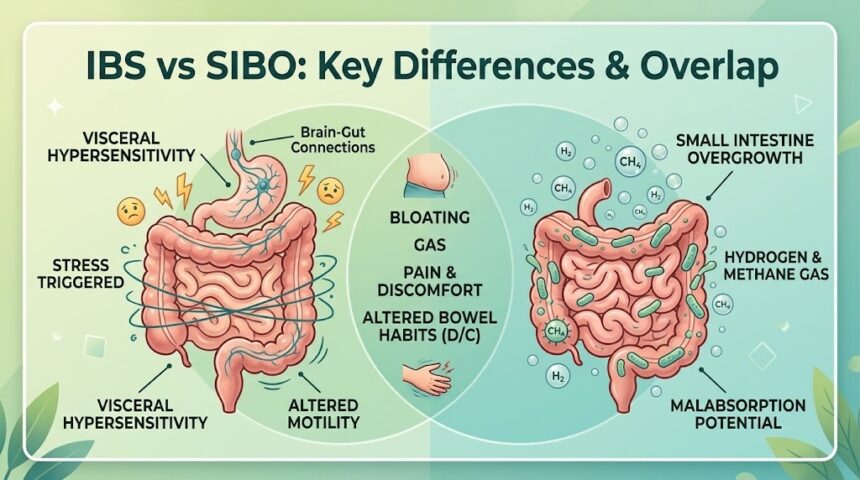
IBS vs SIBO is a common source of confusion because the two conditions share nearly identical symptoms — bloating, gas, abdominal pain, and irregular bowel habits — but they’re diagnosed and treated differently. Understanding the distinction matters because a treatment plan built for one doesn’t reliably work for the other, and some people actually have both at the same time.
This guide breaks down what each condition is, where the symptoms overlap, how they’re diagnosed, and how treatment and diet approaches differ — so you know which questions to bring to your next doctor’s appointment instead of guessing between the two based on symptoms alone.
IBS and SIBO at a Glance
- IBS (irritable bowel syndrome) is a functional gut disorder — the bowel is more sensitive and its muscle timing is off, but standard tests generally look normal.
- SIBO (small intestinal bacterial overgrowth) is a specific, testable condition where bacteria that normally live mostly in the colon overgrow in the small intestine, where far fewer bacteria are supposed to be.
- SIBO can exist as its own condition or as an underlying cause behind some cases of IBS, particularly IBS-D.
What Is IBS?
IBS is diagnosed based on a pattern of symptoms — recurring abdominal pain linked to bowel habit changes — after other conditions have been ruled out. There’s no single blood test or scan that confirms IBS; the diagnosis relies on symptom criteria (often Rome criteria) plus normal results on standard testing. For a full breakdown of symptoms and subtypes, see our guide on IBS symptoms, triggers, and relief tips.
What Is SIBO?
SIBO happens when bacteria overgrow in the small intestine, where they ferment carbohydrates too early in the digestive process. That fermentation produces excess gas — hydrogen, methane, or both — leading to bloating, discomfort, and altered bowel habits. Unlike IBS, SIBO has an objective test: a breath test that measures hydrogen and methane after drinking a sugar solution. For more detail, see our full guide on SIBO symptoms, causes, and treatment.
Symptom Overlap: Why They’re Often Confused
Both conditions commonly involve:
- Bloating, especially worsening through the day
- Excess gas
- Abdominal pain or cramping
- Diarrhea, constipation, or a mix of both
- Symptoms that seem tied to specific foods
Because the symptom lists look almost identical on paper, it’s genuinely difficult to tell them apart by symptoms alone — which is exactly why testing matters, and why some people are treated for IBS for years before SIBO is identified as an underlying driver. A few subtle clues can hint at SIBO specifically: bloating that appears fast, often within 30–90 minutes of eating rather than building gradually through the day, and a stronger, more predictable link to specific fermentable carbohydrates rather than a broad mix of stress, food, and hormonal triggers.
Key Differences Between IBS and SIBO
| Feature | IBS | SIBO |
|---|---|---|
| Nature of the condition | Functional — gut sensitivity and motility issue | Structural/microbial — bacterial overgrowth in the small intestine |
| Diagnostic test | No specific test; symptom-based criteria after ruling out other causes | Breath test measuring hydrogen/methane gas |
| Underlying cause | Gut-brain axis dysfunction, prior infection, stress, genetics | Bacteria overgrowing where they shouldn’t be, often due to slow motility, structural issues, or prior infection |
| Bloating pattern | Variable, often worsens with stress or trigger foods | Often worsens specifically and predictably after eating fermentable carbs |
| Response to antibiotics | Not a standard treatment | Often a first-line treatment (e.g., rifaximin) |
Can You Have Both IBS and SIBO?
Yes. Research suggests a meaningful subset of people diagnosed with IBS, particularly IBS-D, test positive for SIBO when specifically tested. In these cases, SIBO may be an underlying contributor to IBS-like symptoms rather than a separate, unrelated condition. This is part of why symptoms that don’t fully respond to standard IBS management — like a low-FODMAP diet and stress care — sometimes warrant a SIBO breath test as a next step. It also explains why some people notice real, though incomplete, relief from IBS-focused strategies: those strategies may be managing part of the picture (gut sensitivity, motility, stress response) while leaving an underlying bacterial overgrowth untreated.
How Each Is Diagnosed
IBS diagnosis
A doctor typically reviews your symptom pattern against diagnostic criteria, asks about red-flag symptoms (unexplained weight loss, blood in stool, fever, anemia, symptoms starting after age 50), and may order blood work, stool tests, or a colonoscopy to rule out other conditions like IBD or celiac disease. IBS is essentially a diagnosis reached after other explanations are excluded.
SIBO diagnosis
SIBO is diagnosed with a breath test: you drink a glucose or lactulose solution, then breathe into a collection device at set intervals over a few hours. Elevated hydrogen or methane levels early in the test suggest bacterial overgrowth in the small intestine rather than normal fermentation happening later in the colon.
Treatment Differences
IBS treatment approach
- Dietary changes, often including a supervised low-FODMAP trial
- Stress management and gut-directed therapies like CBT
- Fiber adjustments suited to the IBS subtype
- Medications targeted at the dominant symptom (antispasmodics, loperamide for IBS-D, osmotic laxatives for IBS-C)
SIBO treatment approach
- Antibiotics such as rifaximin, sometimes combined with a second antibiotic for methane-predominant SIBO
- Addressing the underlying cause where possible — such as motility issues or structural abnormalities — to reduce recurrence
- A temporary low-fermentation diet during and shortly after treatment, then broadening the diet again
- Retesting after treatment to confirm the overgrowth has cleared
Diet Differences: Low-FODMAP vs SIBO-Specific Diets
A low-FODMAP diet is the standard dietary approach for IBS — it reduces fermentable carbohydrates broadly to calm symptoms, then reintroduces them to map personal triggers. SIBO-specific diets (such as a low-fermentation or SIBO-specific food plan) work on a similar principle but are typically used short-term, alongside antibiotic treatment, rather than as a long-term management tool. Neither diet is meant to be permanent; both are diagnostic or supportive tools used for a defined period, then loosened based on what’s actually confirmed as a trigger.
Risk Factors: What Makes SIBO More Likely
SIBO doesn’t happen randomly — it usually has a mechanical or motility reason behind it. Common contributors include:
- Slow gut motility — when the small intestine’s natural “cleaning wave” (the migrating motor complex) is sluggish, bacteria that would normally be swept toward the colon linger and multiply instead
- Structural issues — prior abdominal surgery, strictures, or diverticula can create pockets where bacteria accumulate
- Low stomach acid — acid helps limit bacterial growth in the upper gut; long-term use of acid-suppressing medication is a recognized risk factor
- Prior gastrointestinal infection — a bout of food poisoning or gastroenteritis can disrupt normal motility for months afterward, a pattern sometimes linked to both post-infectious IBS and SIBO
- Certain chronic conditions — diabetes, scleroderma, and hypothyroidism are all linked to slower gut transit and higher SIBO risk
IBS, by contrast, doesn’t have this kind of clear mechanical risk-factor list. Its contributors are broader and less structural: genetics, prior gut infection, gut-brain axis sensitivity, and psychological stress all play a role, without a single identifiable mechanical cause the way SIBO often has.
Methane vs Hydrogen SIBO: Why the Type Matters
Not all SIBO looks the same on a breath test, and the gas type produced tends to line up with different bowel patterns. Hydrogen-dominant SIBO is more often associated with diarrhea, while methane-dominant overgrowth (technically involving different microbes, sometimes labeled IMO) is more often linked to constipation, since methane gas appears to slow intestinal transit. This distinction matters clinically because treatment sometimes differs — methane-predominant cases may need a different antibiotic combination than hydrogen-predominant ones. IBS testing doesn’t involve this kind of gas-type breakdown at all, since IBS isn’t a gas-overgrowth diagnosis in the first place.
Why Getting the Right Label Matters
Being told “it’s IBS” when the underlying issue is untreated SIBO means the actual driver of symptoms — bacterial overgrowth — never gets addressed, even if diet and stress management genuinely help take the edge off. Conversely, assuming every case of bloating is SIBO and pursuing repeated antibiotic courses without a confirmed positive breath test can disrupt the gut microbiome unnecessarily. The practical takeaway is that persistent, poorly explained bloating and irregular bowel habits are worth a specific conversation with a doctor about which condition — or both — actually fits your case, rather than assuming a diagnosis based on symptoms alone.
When to See a Doctor
See a doctor rather than self-diagnosing if symptoms are persistent, especially with any of the following: unexplained weight loss, blood in stool, fever, anemia, symptoms that wake you at night, or new digestive symptoms starting after age 50. These aren’t typical of either uncomplicated IBS or SIBO and need direct evaluation. If you’ve already been managing IBS without full relief, mention SIBO testing as a specific option at your next appointment rather than assuming it’s been considered.
Living With IBS, SIBO, or Both: Practical Day-to-Day Tips
Whichever diagnosis fits your situation, a few practical habits reduce flare frequency regardless of which condition is driving symptoms:
- Keep a symptom-and-food log for at least two weeks before your appointment — a clinician can act on specific patterns far faster than a vague description of “bad bloating.”
- Space meals out rather than grazing constantly; for SIBO specifically, gaps between meals give the small intestine’s natural cleaning wave a chance to work, which grazing interrupts.
- Don’t start antibiotics or long elimination diets on your own based on an online symptom checklist — both IBS and SIBO treatment plans work best when matched to an actual diagnosis rather than a guess.
- Reassess if a treatment plan isn’t working after a fair trial. A low-FODMAP diet that hasn’t helped after several weeks, or IBS medication with no real improvement, is a reasonable trigger to ask specifically about SIBO testing.
- Track what actually changes symptoms — antibiotics, diet, stress reduction, or a specific food group — since that response itself often gives clues about which condition, or combination, is actually in play.
Frequently Asked Questions
Is SIBO a type of IBS?
No. SIBO is a distinct, testable condition. It can occur alongside IBS, and some IBS cases have SIBO as an underlying driver, but they aren’t the same diagnosis.
Which is more common, IBS or SIBO?
IBS is diagnosed far more often overall, but that partly reflects how much more commonly it’s tested for. SIBO testing is less routine, so its prevalence within the IBS population is likely underestimated.
Can treating SIBO cure my IBS?
If SIBO was an underlying driver of your symptoms, treating it can significantly improve or resolve them. If your IBS isn’t related to bacterial overgrowth, SIBO treatment won’t address the underlying cause.
Do IBS and SIBO require different breath tests?
IBS has no specific breath test — diagnosis is symptom-based. SIBO specifically requires a hydrogen/methane breath test, which IBS diagnosis does not use.
Should I ask for a SIBO test if I already have an IBS diagnosis?
It’s a reasonable question to raise, especially if standard IBS management (diet, stress care, first-line medication) hasn’t given meaningful relief after a fair trial. Your doctor can decide whether testing makes sense for your specific symptom pattern.
Related reading
- IBS symptoms explained: triggers and relief tips
- SIBO: symptoms, causes, and treatment
- Low FODMAP diet guide: food list and IBS tips
- Bloating causes and relief
- Gut-brain connection explained
- Leaky gut syndrome: causes, symptoms, and evidence
Informational only — not a diagnosis or treatment plan. See a qualified clinician for personal medical advice and testing.