
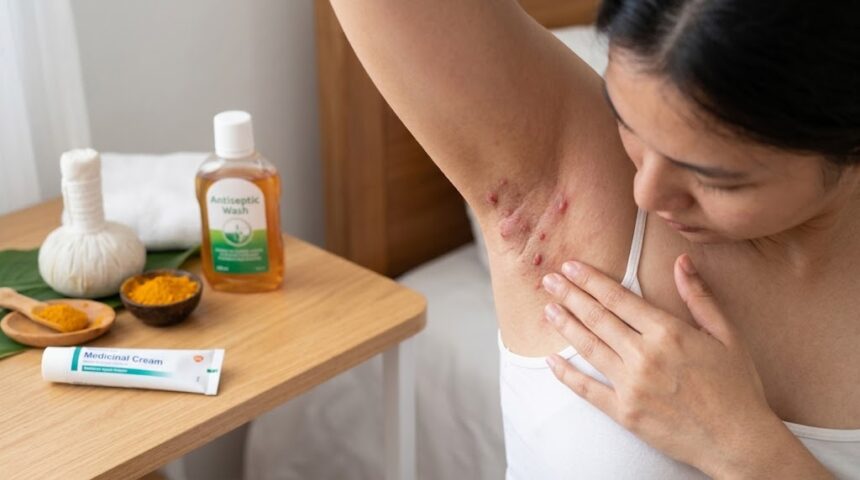
Hidradenitis suppurativa (HS) symptoms include painful, recurring lumps or boil-like nodules in areas with skin folds and sweat glands — most commonly the armpits, groin, buttocks, and under the breasts — that can rupture, drain, and lead to tunneling under the skin (sinus tracts) and scarring over time if untreated. It’s a chronic inflammatory skin condition, not an infection or hygiene issue, affecting roughly 1-4% of people, more commonly women, and typically starting after puberty.
This guide covers the specific symptoms and stages of HS, what causes it, how it’s diagnosed, and current treatment approaches, since early treatment significantly affects long-term outcomes.
What Is Hidradenitis Suppurativa?
Hidradenitis suppurativa is a chronic inflammatory skin condition affecting hair follicles in areas with a high concentration of apocrine (sweat) glands, primarily the armpits, groin, inner thighs, buttocks, and under the breasts. It occurs when hair follicles become blocked and inflamed, leading to painful nodules that can rupture and, over repeated episodes, form tunnels under the skin (sinus tracts) and significant scarring. Despite historically being called “acne inversa,” it’s now understood to be a distinct condition from acne, involving different underlying mechanisms.
What Are the Symptoms of Hidradenitis Suppurativa?
Early Symptoms
Small, painful, firm lumps or nodules resembling boils or cysts, typically in the armpits, groin, under the breasts, or buttocks, that may come and go initially, sometimes mistaken for ingrown hairs, folliculitis, or recurring boils before a proper diagnosis is made.
Progressive Symptoms
As HS progresses without treatment, nodules can become larger and more painful, rupture and drain foul-smelling pus, recur repeatedly in the same areas, and lead to tunnels forming under the skin (sinus tracts) that connect multiple lesions, along with thick, rope-like scarring in affected areas over time.
Associated Symptoms
Many people with HS also experience itching or burning in affected areas before a nodule fully develops, skin discoloration and hardened, thickened skin (fibrosis) in chronically affected areas, and in more severe cases, restricted movement in affected joints (particularly the armpits or groin) due to scarring and skin tightness.
The Hurley Staging System
Doctors often classify HS severity using the Hurley staging system: Stage I involves isolated nodules or abscesses without tunneling or significant scarring. Stage II involves recurrent nodules with limited tunnel formation and scarring, with lesions that are separated rather than widely connected. Stage III involves diffuse, widespread involvement with multiple interconnected tunnels and abscesses across an entire affected area. This staging helps guide treatment intensity, since earlier-stage disease generally responds better to less invasive treatment.
What Causes Hidradenitis Suppurativa?
The exact cause of HS isn’t fully understood, but it’s now recognized as an immune-mediated inflammatory condition rather than a hygiene or infection issue. Contributing factors include genetics, since roughly a third of people with HS have a family history of the condition, hormonal influences, given its typical onset after puberty and frequent flares around the menstrual cycle, smoking, which is strongly associated with both HS development and worse severity, obesity, which is associated with increased friction, sweating, and inflammation in skin folds, and immune system dysregulation, involving an overactive inflammatory response in the affected hair follicles.
Is Hidradenitis Suppurativa Contagious or Caused by Poor Hygiene?
No to both. HS is not an infection and cannot be spread through contact, and it is not caused by inadequate washing or hygiene, despite the visible pus and drainage sometimes leading to this assumption. It’s an inflammatory condition with a genetic and immune component, and improving hygiene alone doesn’t resolve or prevent it, though gentle skin care can help manage some symptoms and reduce secondary bacterial infection risk.
Who Is Most at Risk of Hidradenitis Suppurativa?
Certain groups face a notably higher likelihood of developing HS. Women are affected roughly two to three times more often than men, and onset typically occurs after puberty, most commonly in the teens to thirties. People who smoke face a substantially higher risk, and smoking is also linked to more severe disease once it develops. People who are overweight or obese have a higher likelihood of HS, likely related to increased friction, sweating, and inflammatory load in skin folds. People with a family history of HS have a meaningfully increased risk, reflecting the condition’s genetic component. HS is also more commonly diagnosed in people with certain other conditions, including inflammatory bowel disease, metabolic syndrome, and PCOS, suggesting some shared underlying inflammatory or hormonal pathways.
How Is Hidradenitis Suppurativa Diagnosed?
HS is primarily diagnosed clinically, based on the characteristic appearance, location, and recurring pattern of lesions, along with a physical exam and medical history. There’s no single definitive lab test for HS, though a doctor may take a swab or biopsy to rule out other conditions like recurring boils from a specific infection, or use imaging (like ultrasound) in some cases to assess the extent of tunneling under the skin, particularly when planning treatment or surgery.
How Is Hidradenitis Suppurativa Treated?
Lifestyle and Self-Care
Smoking cessation is one of the most impactful changes people with HS can make, given the strong association between smoking and disease severity. Weight management, where relevant, can reduce friction and inflammation in affected skin folds. Loose, breathable clothing reduces friction in affected areas.
Topical and Oral Medications
Topical or oral antibiotics (like clindamycin) are commonly used for mild-to-moderate HS, working through anti-inflammatory effects as well as targeting bacteria. Oral retinoids are sometimes used, though with caution and specific timing around pregnancy planning. Hormonal treatments, such as certain birth control pills or spironolactone, can help in HS with a clear hormonal pattern.
Biologic Medications
For moderate-to-severe HS, biologic medications that target specific inflammatory pathways (such as TNF-alpha inhibitors) have become an important treatment option, often producing significant improvement in more severe or treatment-resistant cases.
Procedures and Surgery
Incision and drainage can provide short-term relief for an acute, painful nodule, though it doesn’t address the underlying tunnels and tends to have high recurrence. Deroofing procedures remove the roof of a chronic tunnel to promote healing from within. Wide surgical excision, removing the affected skin and tunnels entirely, is generally reserved for severe, extensive, or treatment-resistant disease.
Can Hidradenitis Suppurativa Be Cured?
There’s currently no permanent cure for HS, but it can often be effectively managed with the right combination of treatments, particularly when started early before significant tunneling and scarring develop. Many people achieve substantial symptom control and reduced flare frequency with consistent treatment, even though the underlying tendency toward the condition typically remains. This is why early diagnosis and starting appropriate treatment matters significantly for long-term outcomes and quality of life.
When to See a Doctor
See a doctor, ideally a dermatologist, if you’re experiencing recurring, painful lumps in the armpits, groin, or other skin fold areas, especially if they keep coming back in the same spots, lesions are draining pus or have a foul odor, you notice tunneling or connected areas under the skin, or previous “boils” haven’t responded to typical treatment and keep recurring, since early, specialist involvement significantly improves long-term management and reduces the risk of progression to more severe disease stages.
Frequently Asked Questions
What are the first signs of hidradenitis suppurativa?
Early signs typically include small, painful, recurring lumps resembling boils or cysts in the armpits, groin, or under the breasts, often initially mistaken for ingrown hairs or regular boils before a pattern of recurrence becomes clear.
Is hidradenitis suppurativa an autoimmune disease?
It’s classified as an immune-mediated inflammatory condition rather than a classic autoimmune disease, though it shares some overlapping inflammatory pathways and is sometimes associated with other immune-related conditions like inflammatory bowel disease.
Does losing weight help hidradenitis suppurativa?
For people who are overweight, weight loss can help reduce friction, sweating, and inflammation in affected skin folds, often improving symptom severity, though it doesn’t eliminate the underlying condition entirely for most people.
Can hidradenitis suppurativa go away on its own?
It’s a chronic condition that generally doesn’t resolve completely on its own, though symptom severity can fluctuate over time, and some people experience periods of improvement, particularly with effective treatment and lifestyle changes like smoking cessation.
Is hidradenitis suppurativa the same as boils?
No, though early HS lesions can look similar to a single boil. Boils are typically an isolated bacterial infection of a hair follicle, while HS is a chronic condition causing recurring lesions in characteristic locations, often progressing to tunneling and scarring if untreated, which distinguishes it from an isolated, one-time boil.
Does diet affect hidradenitis suppurativa?
Some people report that certain foods, particularly dairy and high-glycemic foods, seem to worsen their symptoms, similar to some reports in acne, though the evidence for specific dietary triggers in HS is still developing and response varies significantly between individuals.
Can men get hidradenitis suppurativa?
Yes, though it’s less common in men than in women, occurring at roughly a third of the rate. When HS does occur in men, it’s more likely to be diagnosed later and can sometimes present with more severe disease at diagnosis, possibly related to delayed recognition of the condition in this group.
Is hidradenitis suppurativa linked to any other health conditions?
Yes, HS is associated with a higher likelihood of several other conditions, including inflammatory bowel disease (Crohn’s disease and ulcerative colitis), metabolic syndrome, type 2 diabetes, and PCOS, suggesting shared inflammatory or hormonal mechanisms; this is part of why a broader health evaluation is sometimes recommended alongside HS-specific treatment.
Related Reading
- Folliculitis treatment: causes, symptoms, and how to clear it up
- Cystic acne treatment: causes, options, and how to avoid scarring
- Chest acne causes: why it happens and how to treat it
- Best diet for PCOS: what actually helps and what to eat
Informational only — not medical advice. See a dermatologist for a proper evaluation and treatment plan if you suspect hidradenitis suppurativa.