
Acne causes and treatment are two sides of the same question: breakouts start when hair follicles get clogged with oil (sebum) and dead skin cells, and treatment works by targeting whichever part of that process is driving your flare-ups. Acne affects most people at some point — not just teenagers — and the good news is that nearly every case responds to the right combination of consistent care and, when needed, medical treatment. Acne is not caused by dirty skin, and scrubbing harder almost always makes it worse.
How Acne Actually Forms
Every hair follicle on your skin has a small oil gland attached to it. Under normal conditions, that oil travels up the follicle and out onto the skin surface, keeping it lubricated. Acne begins when this system breaks down in four connected steps:
- Excess oil production floods the follicle, usually triggered by hormones.
- Dead skin cells that would normally shed instead stick together and clog the follicle opening.
- Bacteria (C. acnes), which live harmlessly on everyone’s skin, multiply rapidly inside the oxygen-poor, oily, blocked follicle.
- Inflammation follows as the immune system responds to the bacterial overgrowth, producing the redness, swelling, and pain associated with a breakout.
Understanding this chain is useful because most effective treatments target one specific step — which is why combining ingredients that hit different steps (oil control plus exfoliation plus anti-bacterial action) usually outperforms using just one product.
What Causes Acne?
Hormones
Hormonal shifts are the single biggest driver of acne. Androgens (a group of hormones present in everyone) stimulate oil glands to produce more sebum. This is why breakouts commonly appear:
- During puberty, when androgen levels rise sharply
- In the week before a menstrual period
- During pregnancy or after stopping hormonal birth control
- With conditions like polycystic ovary syndrome (PCOS), which involves higher androgen levels
Hormonal acne tends to cluster along the jawline, chin, and lower cheeks, and often shows up as deeper, tender bumps rather than surface blackheads.
Genetics
If your parents had moderate to severe acne, you are statistically more likely to as well. Genetics influence oil gland size, how quickly skin cells shed, and how strongly your immune system reacts to C. acnes — three of the four steps in the acne cycle.
Skincare and makeup products
“Comedogenic” ingredients — heavy oils, waxes, and certain silicones — can physically clog pores. Reading labels for “non-comedogenic” or “oil-free” matters more than the price of the product.
Diet
The research here is mixed but not nothing. Several studies have linked high-glycemic diets (white bread, sugary drinks, refined carbs) and dairy — particularly skim milk — to worse acne in some people. This does not mean diet alone causes or cures acne, and cutting out entire food groups without evidence of a personal trigger is rarely worth the effort. If you suspect a specific food is a trigger, an elimination-and-reintroduction approach over several weeks is more useful than guessing.
Stress
Stress raises cortisol, which in turn increases oil production. It doesn’t create acne from nothing, but it reliably makes existing acne worse — which is why breakouts often cluster around exams, deadlines, or major life events.
Friction and occlusion
Helmets, chin straps, tight collars, and even resting your phone against your cheek can trigger “acne mechanica” — breakouts caused by repeated friction and trapped heat/sweat rather than hormones.
Types of Acne (and Why It Matters for Treatment)
Not all acne is the same, and mismatching treatment to type is the most common reason people feel like “nothing works.”
- Blackheads (open comedones) — clogged pores that oxidize and turn dark at the surface. Not caused by dirt.
- Whiteheads (closed comedones) — the same clogged pore, but sealed under the skin, appearing as small flesh-colored or white bumps.
- Papules — small, inflamed, red bumps without visible pus, tender to the touch.
- Pustules — what most people picture as a “pimple”: a red base with a visible white or yellow pus-filled center.
- Nodules — larger, firmer lumps that form deep under the skin and can be painful for weeks.
- Cysts — the most severe form: deep, soft, pus-filled lumps that carry the highest risk of permanent scarring.
Comedonal acne (blackheads/whiteheads) typically responds well to over-the-counter exfoliants. Inflammatory acne (papules/pustules) usually needs an anti-bacterial or anti-inflammatory ingredient added. Nodular and cystic acne almost always need a dermatologist’s involvement.
Acne Treatment That Actually Works
Over-the-counter active ingredients
- Benzoyl peroxide — kills C. acnes bacteria directly and reduces inflammation. Effective for most mild to moderate acne. Start at a lower concentration (2.5%) since higher percentages are not necessarily more effective and cause more dryness. It can bleach fabric and hair, so use white pillowcases and towels.
- Salicylic acid — a beta-hydroxy acid that dissolves the “glue” holding dead skin cells together inside pores. Best for blackheads, whiteheads, and general texture.
- Adapalene 0.1% gel — an over-the-counter retinoid that normalizes skin cell turnover, preventing new clogs from forming. It is one of the most evidence-backed OTC options available and works on both existing acne and prevention, but needs 8-12 weeks of consistent use and can cause an initial “purging” phase of increased breakouts before it improves.
- Niacinamide — not a primary acne treatment, but useful alongside the above for calming redness and supporting the skin barrier, which reduces irritation from stronger actives.
Building a Simple, Effective Routine
Morning:
- Gentle, fragrance-free cleanser
- Lightweight, oil-free moisturizer
- Broad-spectrum sunscreen (SPF 30+) — essential if you’re using any acid or retinoid, which increase sun sensitivity
Evening:
- Cleanser (double-cleanse only if wearing makeup or sunscreen)
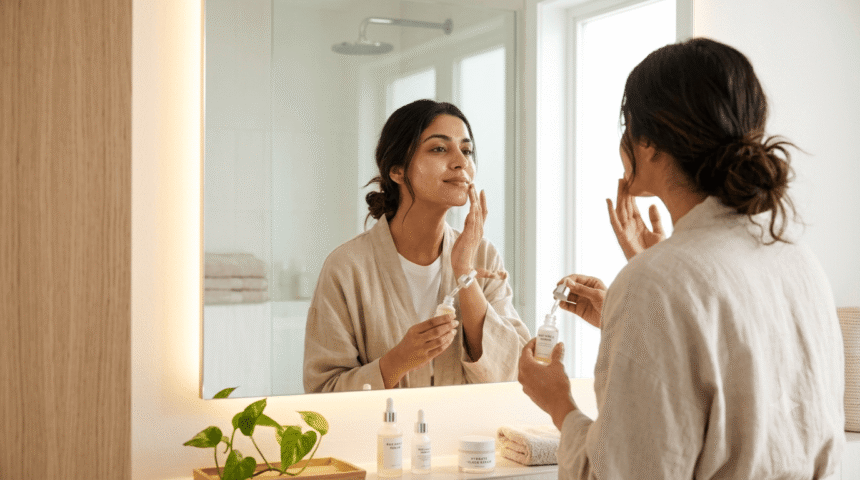
- Active treatment — benzoyl peroxide, salicylic acid, or adapalene, applied a pea-sized amount to the whole affected area, not just individual spots
- Moisturizer to offset dryness from the active ingredient
Introduce one new active ingredient at a time, 2-3 times a week initially, building up to daily use over 2-3 weeks as your skin adjusts. This “start low, go slow” approach dramatically cuts down on irritation.
What to Avoid
- Picking, popping, or squeezing — this pushes bacteria and inflammation deeper into the skin and is the single leading cause of acne scarring and dark marks.
- Layering multiple strong actives at once — combining benzoyl peroxide with strong acids or retinoids on the same night often over-dries and damages the skin barrier, which paradoxically triggers more oil production.
- Product-hopping — switching treatments every few days never gives any single product the 6-8 weeks it typically needs to show results.
- Over-cleansing — washing more than twice a day strips protective oils and can worsen acne by triggering rebound oil production.
Acne Myths Worth Retiring
- “Acne means dirty skin.” Acne forms beneath the skin surface, driven by oil and hormones — not surface dirt.
- “Sun exposure clears acne.” Tanning may temporarily mask redness but tends to worsen acne over time and increases skin cancer risk.
- “Toothpaste dries out pimples overnight.” Toothpaste contains irritants that can cause more redness and even chemical burns; it is not a substitute for benzoyl peroxide.
- “Adults don’t get acne.” Adult acne, especially in women in their 20s-40s, is common and often hormonally driven.
Acne and Mental Health
Acne is a medical condition, but its impact often goes beyond the skin. Research consistently links moderate-to-severe acne with lower self-esteem, social anxiety, and in some cases depression — particularly in teens and young adults. If acne is affecting your confidence, sleep, or willingness to go out, that alone is a legitimate reason to seek treatment, not something to “just deal with.” This overlap between physical and mental wellbeing is worth taking seriously, similar to how everyday mental health habits support overall wellbeing.
When to See a Dermatologist
Book an appointment if:
- Acne is nodular, cystic, or already leaving dark marks or textured scars
- Over-the-counter treatment has not improved things after 2-3 months of consistent, correct use
- Acne is affecting your confidence, mood, or daily life
- You suspect a hormonal cause — irregular periods, sudden adult-onset acne, or jawline-clustered breakouts
Dermatologists have access to tools that go beyond the drugstore aisle, including prescription-strength topical retinoids (tretinoin, tazarotene), oral antibiotics for inflammatory acne, hormonal treatments such as combined oral contraceptives or spironolactone for hormonal acne, and isotretinoin for severe, scarring, or treatment-resistant cases. None of these should be started without medical supervision, particularly isotretinoin, which requires monitoring.
Preventing Acne Scars
The best scar prevention is treating active acne early and avoiding picking. Once inflammation has caused a mark, options range from at-home ingredients (like niacinamide and vitamin C for dark marks) to in-office treatments such as chemical peels, microneedling, or laser therapy for textured scarring — all best discussed with a dermatologist once active breakouts are under control. Good overall skin barrier care, similar to the moisturizing routine recommended for dry, damaged skin, also supports faster healing between breakouts.
Frequently Asked Questions
How long does it take for acne treatment to work?
Most over-the-counter treatments need 6-8 weeks of consistent use before you can fairly judge results, and retinoids like adapalene can take 8-12 weeks for full effect.
Can diet alone clear acne?
Diet can be a contributing factor for some people, particularly high-glycemic foods and dairy, but it rarely clears moderate to severe acne on its own without a topical routine.
Is it okay to wear makeup with acne?
Yes, as long as products are labeled non-comedogenic and oil-free, and makeup is removed thoroughly before bed.
Will acne go away on its own?
Mild acne sometimes improves without treatment, especially after hormonal shifts settle, but moderate to severe acne rarely resolves on its own and untreated inflammation increases scarring risk.
Related Reading
- Gut-skin connection: how digestion affects your skin
- Dry Skin Causes and Remedies: Home Care Guide
- Dark Circles Under Eyes: Causes and Natural Fixes
Quick Takeaways
- Acne comes from oil, clogged pores, bacteria, and inflammation — not poor hygiene.
- Benzoyl peroxide, salicylic acid, and adapalene are the best-evidenced OTC ingredients.
- Give any new routine 6-8 weeks before judging results, and introduce actives gradually.
- Never pick at breakouts — it is the top cause of scarring.
- See a dermatologist for cystic acne, scarring, hormonal patterns, or no improvement after consistent OTC treatment.