
Scalp psoriasis is a form of psoriasis that causes red, raised, scaly patches on the scalp, often extending onto the forehead, back of the neck, or behind the ears. It’s caused by the same autoimmune process as psoriasis elsewhere on the body — an overactive immune response that speeds up skin cell turnover — and affects roughly half of all people who have psoriasis at some point. It’s treated with medicated shampoos, topical steroids, and, for more severe or widespread cases, systemic medications, though because the scalp has hair that makes application harder, it’s often managed with different formulations than psoriasis on smooth skin.
This guide covers what causes scalp psoriasis, how it’s treated, how it differs from dandruff and seborrheic dermatitis, whether it can cause hair loss, and what to do to manage flares day to day.
What Is Scalp Psoriasis?
Scalp psoriasis is psoriasis that specifically affects the scalp, causing thick, red, well-defined patches covered in silvery-white scale. It can appear as a few small patches or cover the entire scalp, and can extend past the hairline onto the forehead, ears, or back of the neck. It’s not caused by poor hygiene or a scalp infection — like psoriasis elsewhere on the body, it’s driven by an autoimmune process that accelerates skin cell production.
What Causes Scalp Psoriasis?
Scalp psoriasis has the same underlying cause as psoriasis anywhere else on the body: the immune system mistakenly attacks healthy skin cells, triggering inflammation and a much faster-than-normal skin cell turnover cycle. This causes cells to build up on the surface faster than they can shed, forming the characteristic thick, scaly patches. Common triggers that can bring on a flare include stress, cold or dry weather, skin injury or irritation (including from scratching or harsh hair products), certain infections, and specific medications. Genetics also play a significant role, and having a family history of psoriasis increases the likelihood of developing it.
What Does Scalp Psoriasis Look Like?
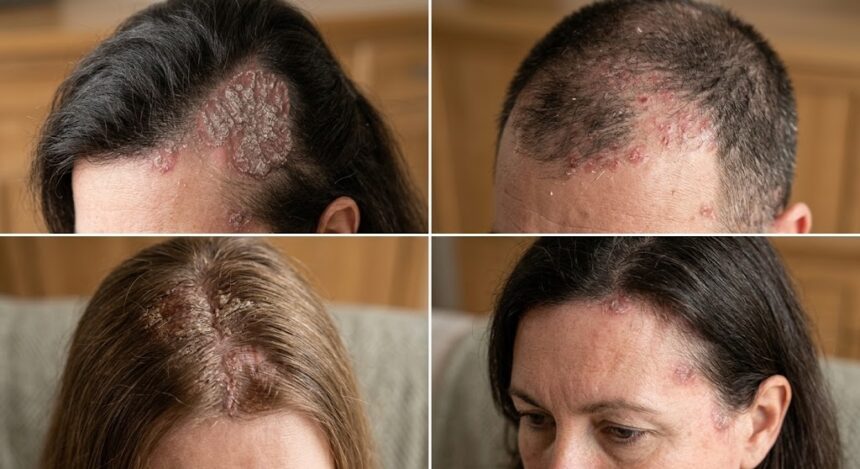
Red, raised patches covered in silvery-white or grayish scale, ranging from small, isolated spots to patches covering the entire scalp, that can extend beyond the hairline onto the forehead, temples, back of the neck, or behind and inside the ears. The scalp often feels itchy, sometimes intensely, and can feel tight, sore, or burning during flares. Scratching can worsen scaling and, in some cases, contribute to temporary hair thinning in affected areas, though psoriasis itself doesn’t typically cause permanent hair loss.
Is Scalp Psoriasis the Same as Dandruff?
No, though the flaking can look similar at a glance. Dandruff typically causes fine, white or yellowish flakes without significant redness or thick scale buildup, and isn’t associated with an autoimmune process. Scalp psoriasis produces thicker, more adherent, silvery scale on top of clearly red, raised, well-defined patches, and often causes more significant itching and discomfort than typical dandruff. Over-the-counter dandruff shampoo alone is usually insufficient for scalp psoriasis, since it doesn’t address the underlying inflammatory process driving the buildup.
Scalp Psoriasis vs. Seborrheic Dermatitis
These two conditions are frequently confused because both cause scaly patches on the scalp, but they have different causes and sometimes need different treatment. Scalp psoriasis causes thicker, more sharply defined patches with a drier, silvery scale, and is driven by an autoimmune process. Seborrheic dermatitis causes greasier, yellowish scale on a background of milder redness, is linked to an overgrowth of Malassezia yeast combined with excess oil production, and tends to be less thick and well-defined than psoriasis plaques. It’s possible to have both conditions at once, sometimes called “sebopsoriasis,” which can make self-diagnosis particularly difficult and is often better sorted out by a dermatologist.
Does Scalp Psoriasis Cause Hair Loss?
Psoriasis itself doesn’t directly destroy hair follicles, so hair loss isn’t typically a permanent feature of the condition. However, temporary hair thinning or shedding can happen due to intense scratching, aggressive removal of thick scale, inflammation putting stress on hair follicles during severe flares, or certain treatments used for very severe cases. In most cases, hair regrows once the scalp inflammation is controlled and scratching or scale removal is minimized, though this can take time.
Who Is More Likely to Get Scalp Psoriasis?
Scalp psoriasis can affect anyone with psoriasis, but certain factors raise the likelihood. Having a family history of psoriasis significantly increases individual risk, since genetics play a major role in who develops the condition. People who already have psoriasis elsewhere on the body are more likely to eventually develop scalp involvement as well, since it affects roughly half of people with psoriasis at some point. Certain triggers, including significant stress, skin injury from scratching or harsh hair treatments, specific infections, and some medications, can bring on a first flare or worsen existing scalp psoriasis in people already predisposed to it.
How to Treat Scalp Psoriasis
Treatment usually starts with topical options and escalates based on severity and response.
Medicated Shampoos
Shampoos containing coal tar or salicylic acid are commonly used first-line options — coal tar helps slow skin cell turnover and reduce inflammation, while salicylic acid helps soften and lift thick scale, making other treatments more effective. These are typically used a few times a week, left on the scalp for the recommended time before rinsing.
Topical Corticosteroids
Topical steroids formulated for the scalp — foams, solutions, oils, or shampoos rather than thick creams — are commonly prescribed to reduce inflammation and itching during flares. Because the scalp absorbs medication somewhat differently than smooth skin, and because prolonged steroid use carries risks like skin thinning, these are typically used for defined periods rather than continuously.
Vitamin D Analogues
Topical vitamin D analogues, sometimes combined with a corticosteroid in a single product, help slow the excessive skin cell turnover driving psoriasis and are often used for longer-term maintenance between flares, since they don’t carry the same risks as prolonged steroid use.
Systemic and Biologic Treatment
For scalp psoriasis that’s severe, widespread, or resistant to topical treatment, or when it’s part of more extensive psoriasis elsewhere on the body, a dermatologist may recommend oral systemic medications or biologic injections that work throughout the body to calm the overactive immune response. These are typically reserved for moderate-to-severe cases given their cost and potential side effects.
Phototherapy
Targeted UV light treatment can help scalp psoriasis, though it’s more challenging to deliver evenly to the scalp because of hair, and is generally more practical for thinner hair or shorter hairstyles.
Tips for Managing Scalp Psoriasis at Home
- Avoid scratching or picking at scale, which can worsen inflammation, cause bleeding, and increase infection risk
- Soften thick scale with a salicylic acid product or warm oil before gently combing it out, rather than forcibly removing it dry
- Use a gentle, fragrance-free shampoo alongside medicated treatment to avoid additional irritation
- Avoid harsh hair treatments (bleaching, chemical relaxers, tight hairstyles) during active flares, since these can aggravate the scalp
- Manage stress where possible, since it’s a common flare trigger for many people with psoriasis
- Keep the scalp moisturized between shampoo treatments, since dryness can worsen scaling and itch
How Long Does Scalp Psoriasis Treatment Take to Work?
Many people notice reduced itching and redness within a few weeks of starting appropriate topical treatment, while significant scale clearing often takes 4-8 weeks of consistent use. Like psoriasis elsewhere on the body, scalp psoriasis is a chronic condition that tends to flare and improve in cycles rather than being permanently cured, so most treatment plans focus on controlling flares and extending the time between them rather than expecting complete, permanent resolution.
When to See a Dermatologist
While mild scalp psoriasis can sometimes be managed with over-the-counter medicated shampoos, it’s worth seeing a dermatologist if over-the-counter treatment hasn’t helped after several weeks, the psoriasis is spreading, thick, or significantly affecting your scalp comfort or confidence, you’re noticing hair thinning or shedding that concerns you, there are signs of infection, such as increasing redness, warmth, swelling, or pus, or you’re unsure whether it’s psoriasis, seborrheic dermatitis, or another scalp condition, since accurate diagnosis shapes which treatment will actually help.
Frequently Asked Questions
What is the best shampoo for scalp psoriasis?
Medicated shampoos containing coal tar or salicylic acid are commonly recommended as a first step, since coal tar helps slow skin cell turnover and salicylic acid helps lift scale. More severe cases often need a prescription topical steroid or vitamin D analogue in addition to shampoo alone.
Can scalp psoriasis cause permanent hair loss?
Not typically. Psoriasis itself doesn’t usually destroy hair follicles permanently, and hair loss associated with it is generally temporary, caused by scratching, scale removal, or inflammation, with regrowth expected once the scalp is treated and irritation is minimized.
How do I know if it’s scalp psoriasis or dandruff?
Scalp psoriasis typically causes thicker, more clearly defined red patches with dry, silvery scale and more intense itching, while dandruff causes finer, looser white or yellow flakes without the same redness or well-defined patches.
Is scalp psoriasis contagious?
No, scalp psoriasis is not contagious. It’s an autoimmune condition, not an infection, so it cannot spread through contact, shared combs, or hats.
Can stress make scalp psoriasis worse?
Yes, stress is a well-recognized trigger for psoriasis flares, including on the scalp, though the exact relationship varies between individuals and psoriasis can also flare without an identifiable trigger.
Do I need a prescription for scalp psoriasis treatment?
Not always. Mild cases can often be managed with over-the-counter medicated shampoos containing coal tar or salicylic acid, but more significant or widespread cases typically need a prescription topical steroid, vitamin D analogue, or systemic treatment for adequate control.
Can I dye or chemically treat my hair if I have scalp psoriasis?
It’s generally best to avoid hair dye, bleach, chemical relaxers, and other harsh treatments during an active flare, since they can irritate already-inflamed skin and worsen symptoms. Once the scalp is well controlled, many people can tolerate gentler treatments, though patch-testing and consulting a dermatologist first is a reasonable precaution.
Does scalp psoriasis get worse in winter?
For many people, yes. Cold, dry air tends to reduce skin moisture and can trigger or worsen psoriasis flares, including on the scalp, which is one reason consistent moisturizing and treatment adherence often need to increase during colder months.
Related Reading
- Seborrheic dermatitis: causes, symptoms, and treatment
- Psoriasis vs eczema: key differences and how to tell them apart
- Dry skin causes and remedies: home care guide
Informational only — not a diagnosis. See a dermatologist for a proper evaluation, especially if scale is thick, spreading, or affecting your hair.