

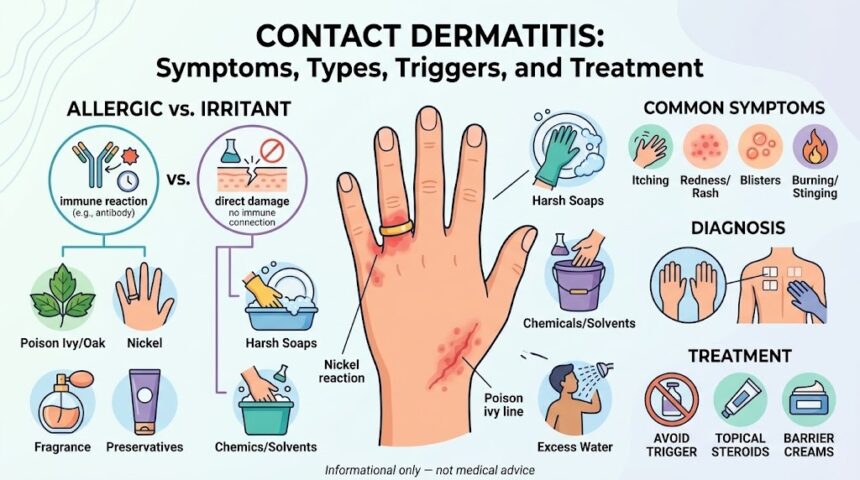
Contact dermatitis is a skin reaction that develops after direct contact with an irritating substance or an allergen, causing redness, itching, and sometimes blistering exactly where the skin touched the trigger. It comes in two main types — irritant contact dermatitis, caused by direct chemical or physical damage to the skin, and allergic contact dermatitis, caused by an immune reaction to a specific substance — and while both look similar, distinguishing them matters because treatment and long-term avoidance strategies differ.
This guide covers the symptoms of contact dermatitis, common triggers, how the two main types differ, and how it’s treated.
What Is Contact Dermatitis?
Contact dermatitis is inflammation of the skin caused by direct contact with a substance that either damages the skin directly or triggers an allergic immune response. It typically appears in the exact shape or pattern of contact — a rash in a straight line where a plant brushed against skin, or a rash matching the shape of a ring or watch band, is a classic sign that points toward contact dermatitis specifically, as opposed to a more diffuse skin condition.
What Are the Symptoms of Contact Dermatitis?
Common symptoms include redness and inflammation at the site of contact, itching, which can range from mild to intense, burning or stinging, particularly with irritant contact dermatitis, small blisters or bumps, sometimes weeping or oozing in more severe reactions, dry, cracked, or scaly skin, especially with chronic or repeated exposure, and swelling in more significant reactions. Symptoms typically appear within minutes to hours for irritant contact dermatitis, or 12-72 hours after exposure for allergic contact dermatitis, since the allergic type requires the immune system to mount a delayed response.
Irritant vs. Allergic Contact Dermatitis: What’s the Difference?
Irritant Contact Dermatitis
This is the more common type, caused by direct chemical or physical damage to the skin’s protective barrier from repeated or intense exposure to an irritating substance. It doesn’t involve the immune system’s allergic pathway, meaning anyone exposed to a strong enough irritant for long enough can develop it, regardless of individual allergy status. Common causes include frequent hand washing or hand sanitizer use, harsh soaps and detergents, solvents and cleaning chemicals, and prolonged exposure to water (common in people who wash dishes frequently or work in wet conditions).
Allergic Contact Dermatitis
This type occurs when the immune system identifies a specific substance as a threat and mounts an allergic response upon contact, a process called delayed-type hypersensitivity. Unlike irritant contact dermatitis, it only affects people who’ve developed a specific allergy to that substance, and it typically requires a prior sensitizing exposure before the allergy develops. Common triggers include nickel (in jewelry, belt buckles, and buttons), poison ivy, oak, and sumac, fragrances and preservatives in cosmetics and skincare products, certain hair dyes, and latex.
Common Triggers of Contact Dermatitis
- Metals: Nickel is one of the most common allergens, found in jewelry, watches, belt buckles, and even some electronics
- Plants: Poison ivy, oak, and sumac contain urushiol, a resin that triggers a strong allergic reaction in most people who touch it
- Fragrances and preservatives: Common in skincare, cosmetics, and household products, and among the most frequent causes of allergic contact dermatitis from personal care items
- Latex: Found in gloves, balloons, and some medical equipment
- Cleaning products and solvents: A leading cause of irritant contact dermatitis, especially with repeated exposure
- Hair dyes: Particularly those containing paraphenylenediamine (PPD)
- Topical medications: Certain ingredients in topical antibiotics or other creams can trigger allergic reactions with repeated use
Who Is More Likely to Get Contact Dermatitis?
Certain occupations and habits raise the likelihood of developing contact dermatitis, particularly the irritant type. People in healthcare, cleaning, food service, hairdressing, and mechanical trades face frequent exposure to water, chemicals, and irritants, making occupational irritant contact dermatitis one of the most common work-related skin conditions. People with pre-existing eczema or a naturally weaker skin barrier are more prone to irritant contact dermatitis, since their skin has less protective reserve against repeated exposure. People with known metal or fragrance sensitivities are more likely to develop allergic contact dermatitis from jewelry, cosmetics, and personal care products containing those specific allergens. Frequent hand sanitizer or hand-washing habits, which became especially common in recent years, are also a well-recognized contributor to irritant hand dermatitis.
How Is Contact Dermatitis Diagnosed?
Diagnosis usually starts with a physical examination and a detailed history of recent exposures, products used, and the pattern and timing of the rash, since the shape and location often point directly to the trigger. When the cause isn’t obvious, a dermatologist may recommend patch testing, a procedure where small amounts of common allergens are applied to the skin, usually on the back, and left in place for about 48 hours, then checked for a reaction at set intervals. Patch testing is the standard way to confirm allergic contact dermatitis and identify the specific allergen when the trigger isn’t clear from history alone.
How to Treat Contact Dermatitis
Avoid the Trigger
The single most important step is identifying and avoiding the specific irritant or allergen, since ongoing exposure will keep triggering flares regardless of what topical treatment is used. This sometimes requires reading ingredient labels carefully or switching products, jewelry, or work practices.
Topical Treatments
Topical corticosteroids are commonly used to reduce inflammation and itching during a flare, with strength chosen based on severity and location, since thinner skin (like the face) needs a milder formulation than thicker skin (like the palms). Emollients and barrier creams help repair and protect the skin barrier, particularly important for irritant contact dermatitis from repeated exposure to water or chemicals. Cool compresses can help soothe acute, weeping, or blistered reactions.
Oral Treatments
Antihistamines may help reduce itching, particularly at night, though they don’t treat the underlying inflammation directly. Oral corticosteroids are sometimes used for severe, widespread reactions, such as extensive poison ivy exposure, under a doctor’s guidance for a limited course.
How Long Does Contact Dermatitis Take to Clear Up?
Mild contact dermatitis often improves within a few days to two weeks once the trigger is removed and appropriate treatment is started. More severe reactions, particularly from strong allergens like poison ivy or from prolonged irritant exposure, can take two to four weeks to fully resolve. Continued exposure to the trigger, even in small amounts, will prevent healing and can lead to a chronic, recurring pattern, which is why identifying and eliminating the actual cause matters more than treatment alone.
Is Contact Dermatitis Contagious?
No, contact dermatitis itself is not contagious — it can’t spread from person to person through touch. However, if the triggering substance (like poison ivy resin) remains on the skin, clothing, or an object, it can transfer to another person who then touches it, causing them to develop their own reaction to that same substance, which can create the appearance of the rash “spreading” between people.
Can You Develop New Allergies to Products You’ve Used for Years?
Yes, this is a common source of confusion. Allergic contact dermatitis requires a sensitizing exposure before an allergy develops, and this sensitization can happen after months or even years of using a product without any problem. This is why a new rash from a “usual” product isn’t necessarily evidence against that product being the cause — allergic sensitization can develop at any point with repeated exposure, not just on first use.
When to See a Doctor
See a doctor if the rash is widespread, severe, or affecting sensitive areas like the eyes, mouth, or genitals, over-the-counter treatment hasn’t improved symptoms within a week or two, there are signs of infection, such as increasing redness, warmth, swelling, or pus, you’re unsure what’s causing the reaction and it keeps recurring, since patch testing may be needed to identify the specific trigger, or you have difficulty breathing, facial swelling, or other signs of a severe allergic reaction, which needs emergency care.
Frequently Asked Questions
What is the fastest way to get rid of contact dermatitis?
Removing the trigger immediately is the most important step, combined with a topical corticosteroid to reduce inflammation and a cool compress for acute symptoms. Most mild cases improve within a few days to two weeks once the trigger is eliminated.
How do I know if it’s contact dermatitis or something else?
Contact dermatitis typically appears in the shape or pattern of contact with the trigger — a straight line, a ring shape, or matching the outline of a glove or piece of jewelry — which is a distinguishing clue compared to more diffuse skin conditions like eczema or psoriasis.
Can contact dermatitis spread to other parts of the body?
The rash itself doesn’t spread internally, but touching the affected area and then touching other skin, or having the triggering substance still present on hands or clothing, can cause new reactions to appear in other locations.
Is contact dermatitis the same as eczema?
Contact dermatitis is a type of eczema (dermatitis is a general term for skin inflammation), but it’s specifically triggered by direct contact with an irritant or allergen, whereas atopic dermatitis (the most common type people mean by “eczema”) is linked to a genetically weaker skin barrier and allergic-type immune response without necessarily requiring a specific external trigger.
How long does an allergic reaction from poison ivy last?
Poison ivy-related contact dermatitis typically lasts one to three weeks, depending on severity and how much urushiol resin contacted the skin, and can sometimes be prolonged if the resin isn’t fully washed off and continues re-exposing the skin.
Can you become allergic to something you’ve never reacted to before?
Yes, allergic contact dermatitis requires a sensitizing exposure before symptoms develop, which means someone can use a product or come into contact with a substance for months or years before suddenly developing an allergic reaction to it.
What does patch testing involve?
Patch testing involves applying small amounts of common allergens to patches placed on the skin, usually the back, which stay in place for about 48 hours. A dermatologist then checks the skin at set intervals, typically at 48 and 72-96 hours, for any localized reaction, which helps pinpoint the specific substance causing an allergic response.
Can contact dermatitis become a chronic condition?
Yes, if the trigger isn’t identified and avoided, contact dermatitis can become chronic, leading to persistent dryness, thickened skin, and recurring flares, particularly with ongoing occupational exposure to irritants. This is why identifying and eliminating the actual cause is emphasized over relying on repeated topical treatment alone.
Related Reading
- Psoriasis vs eczema: key differences and how to tell them apart
- Dry skin causes and remedies: home care guide
- Seborrheic dermatitis: causes, symptoms, and treatment
Informational only — not a diagnosis. See a dermatologist for patch testing if you have recurring, unexplained contact dermatitis.