
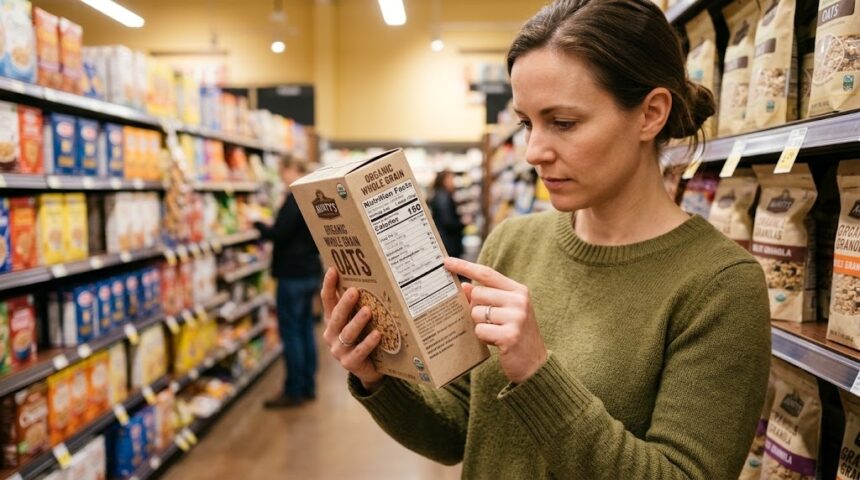
Reading a nutrition label well means checking the serving size first, since every other number on the label is based on it, then looking at calories, % Daily Value for key nutrients, and the ingredients list, which is ordered by weight from most to least. The most useful numbers for most people to focus on are added sugar, sodium, fiber, and the ingredients list itself, since these tell you more about a food’s actual health impact than total calories alone.
This guide breaks down each section of a nutrition label, what the numbers actually mean, and how to use them to compare products quickly while shopping.
Why Nutrition Labels Matter
Nutrition labels exist to give a standardized way to compare foods, since package marketing claims (“natural,” “healthy,” “light”) aren’t regulated as strictly as the nutrition facts panel itself. Learning to read the label quickly lets you see past marketing and compare two similar products — say, two brands of yogurt or bread — on the numbers that actually matter for your health goals.
Step 1: Check the Serving Size First
The serving size, listed at the top of the label, is the foundation for every other number on the panel. If a package contains 2.5 servings and you eat the whole thing, you need to multiply every number on the label by 2.5 to know what you actually consumed. This is one of the most common places people misread labels — a snack that looks like “150 calories” per the label might actually be 375 calories for the whole bag, if the bag contains 2.5 servings. Always check the servings per container, listed just below the serving size, before assuming the numbers apply to the whole package.
Step 2: Look at Total Calories
Calories tell you how much energy a serving provides, but they’re only useful in context. Two foods with the same calorie count can have very different nutritional value — a chocolate bar and a serving of nuts might have similar calories, but very different mixes of sugar, fat, protein, and fiber. Calories are a starting point for understanding portion and energy density, not a complete picture of whether a food is a good choice.
Step 3: Understand % Daily Value (%DV)
The % Daily Value shows how much a serving contributes toward a general daily target, based on a standard 2,000-calorie diet. As a quick guide: 5% DV or less per serving is considered low for that nutrient, and 20% DV or more is considered high. This is genuinely one of the fastest ways to scan a label — you want the %DV to be low for nutrients you’re trying to limit (like added sugar, sodium, and saturated fat) and high for nutrients you’re trying to get more of (like fiber, vitamin D, calcium, iron, and potassium).
Step 4: Check Added Sugars, Not Just “Total Sugars”
This is one of the most important, and most commonly misread, parts of the label. Total sugars include both naturally occurring sugars (like those in fruit or plain dairy) and added sugars (sugar added during processing). Added sugars, listed as a separate line beneath total sugars, is the number that matters most for health, since naturally occurring sugar in whole foods comes packaged with fiber and other nutrients, while added sugar contributes calories with little nutritional benefit. The recommended daily limit for added sugar is roughly 25 grams for women and 36 grams for men, according to commonly cited guidelines, though specific targets can vary.
Step 5: Check Sodium
Most people in the U.S. and many other countries consume more sodium than recommended, largely from processed and packaged foods rather than the salt shaker. A general guideline is that 5% DV or less of sodium per serving is low, and 20% DV or more is high. Checking sodium is particularly important for canned soups, packaged sauces, deli meats, frozen meals, and snack foods, which are often surprisingly high even when they don’t taste overtly salty.
Step 6: Check Fiber
Fiber is one of the nutrients most people don’t get enough of, and it’s directly linked to digestive health, blood sugar regulation, and satiety. Look for at least 3 grams of fiber per serving as a reasonable marker of a good source, and 5 grams or more as an excellent source. Comparing the fiber content of similar products, like different breads or cereals, is one of the most useful comparisons you can make using the label.
Step 7: Check Saturated Fat and Trans Fat
Saturated fat is listed with its own %DV, and keeping it in the low range (5% DV or less per serving) supports cardiovascular health for most people. Trans fat, listed separately, should ideally be as close to zero as possible — even small amounts have been linked to increased cardiovascular risk, which is why trans fats have been phased out of many processed foods in various countries, though “partially hydrogenated oil” in the ingredients list is still worth watching for as a red flag.
Step 8: Read the Ingredients List
The ingredients list is ordered by weight, from most to least, which means the first few ingredients make up the bulk of the product. A cereal that lists sugar as the second or third ingredient, for example, is telling you something important the nutrition panel’s %DV alone might not fully convey. Long ingredient lists with unfamiliar chemical names aren’t automatically unhealthy, but they’re worth a closer look, especially compared against a simpler alternative with recognizable whole-food ingredients.
Understanding Protein and Carbohydrate Lines
Beyond fat and sugar, the protein and total carbohydrate lines help round out the picture, particularly for people managing blood sugar, building muscle, or tracking macronutrients. Total carbohydrate includes fiber, sugar, and starches combined, so it’s the fiber and added sugar breakdown underneath it that gives the more useful detail rather than the total carb number alone. Protein content is useful for comparing similar products, such as different plant-based milk alternatives or protein bars, where the amount can vary significantly between brands despite similar-looking packaging and calorie counts. Neither number tells the whole story on its own, which is part of why reading the label as a full picture, rather than fixating on one number, gives the most accurate sense of a food’s nutritional profile.
How Nutrition Labels Differ Between Countries
Nutrition label formats vary somewhat by country, so it’s worth knowing the format you’re reading. In the United States, the label follows the FDA’s Nutrition Facts format, with %DV based on a 2,000-calorie reference diet. In the European Union, labels often use a “traffic light” or reference intake system showing energy, fat, saturates, sugars, and salt as a percentage of reference intake, sometimes color-coded on the front of the package for a faster read. In Canada, the format is similar to the U.S. but includes a slightly different %DV reference and ingredient listing style. If you’re comparing products from different countries, it’s worth checking which system’s reference values are being used before assuming numbers are directly comparable.
Understanding “Nutrient Content” Claims on Packaging
Front-of-package claims are regulated but often more limited than they sound. “Low fat” typically means 3 grams of fat or less per serving, but says nothing about sugar or sodium content, which can be high in a “low fat” product to compensate for flavor. “Reduced sugar” means at least 25% less sugar than the standard version of that product, but the resulting product can still be high in sugar in absolute terms. “Natural” is a loosely regulated term in many places and doesn’t guarantee a food is minimally processed or free of added sugar and sodium. Reading the actual nutrition panel and ingredients list is more reliable than relying on front-of-package claims alone.
Common Nutrition Label Mistakes
- Ignoring the serving size and assuming the label reflects the whole package
- Focusing on total sugar instead of checking the added sugar line specifically
- Judging a product only by calories, without checking sugar, sodium, or fiber
- Trusting front-of-package claims like “natural” or “light” without checking the actual panel
- Not comparing similar products side by side, which is often the fastest way to spot a meaningfully better option
- Assuming low-fat automatically means healthier, without checking whether sugar was increased to compensate for flavor
A Quick 30-Second Label-Reading Method
- Check the serving size and servings per container first
- Look at added sugar — aim low
- Check sodium — aim low, especially for packaged or processed foods
- Check fiber — aim for 3g or more per serving
- Scan the first three ingredients — these make up most of the product
This quick method won’t replace a deeper nutritional analysis, but it’s enough to compare two similar products in the time it takes to stand in a grocery aisle.
Frequently Asked Questions
What is the most important thing to look at on a nutrition label?
There’s no single most important number for everyone, since priorities depend on individual health goals, but added sugar, sodium, and fiber are generally the three most useful numbers to check quickly, since they tell you the most about a food’s overall health impact.
What does % Daily Value mean on a nutrition label?
It shows how much a nutrient in one serving contributes toward a general daily target based on a 2,000-calorie diet. As a quick rule, 5% DV or less is considered low and 20% DV or more is considered high for that nutrient.
Is total sugar or added sugar more important to check?
Added sugar is generally more important to check for health purposes, since it reflects sugar added during processing rather than sugar naturally present in whole foods like fruit or plain dairy, and it’s more directly linked to excess calorie intake without nutritional benefit.
How much added sugar should I have per day?
Commonly cited guidelines suggest limiting added sugar to about 25 grams per day for women and 36 grams per day for men, though individual needs and specific health conditions can shift this target.
Are ingredients listed in order of amount on food labels?
Yes, ingredients are legally required to be listed in descending order by weight, meaning the first ingredient makes up the largest portion of the product and the last ingredient the smallest.
Does “natural” on a food label mean it’s healthy?
Not necessarily. The term “natural” is loosely regulated in many places and doesn’t guarantee low sugar, low sodium, or minimal processing — checking the actual nutrition panel and ingredients list gives a more reliable picture than the claim alone.
How do I compare two similar products quickly using labels?
Match the serving sizes first, since comparing a 100g serving to a 30g serving is misleading, then compare added sugar, sodium, and fiber side by side. In most cases, the product with lower added sugar and sodium and higher fiber, for a similar serving size and calorie count, is the better nutritional choice.
Related Reading
- Anti-inflammatory foods list: diet plan and joint pain
- Best fiber foods for digestion
- Potassium rich foods
Informational only — not medical advice. See a registered dietitian for personalized nutrition guidance, especially if managing a specific health condition.