
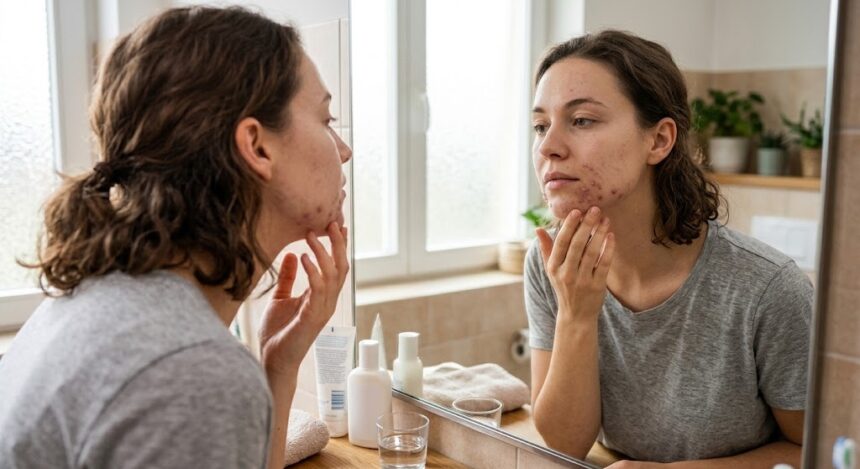
Hormonal acne is caused primarily by androgens (a group of hormones including testosterone) stimulating the skin’s oil glands to produce excess sebum, which combines with dead skin cells to clog pores and trigger inflammation. It’s most strongly associated with puberty, the menstrual cycle, pregnancy, and conditions like PCOS, and is recognizable by its characteristic pattern — deep, often tender breakouts along the jawline, chin, and lower cheeks — that tend to flare in a cyclical, predictable pattern rather than appearing randomly across the face.
This guide covers exactly how hormones trigger acne, the specific pattern that identifies hormonal acne, and evidence-based treatment options ranging from topical products to hormonal medication.
How Do Hormones Cause Acne?
Androgens, a group of hormones that includes testosterone and DHT (dihydrotestosterone), bind to receptors in the skin’s sebaceous (oil) glands, stimulating them to produce more sebum (oil). Everyone, regardless of sex, produces androgens, but fluctuations or relative increases in androgen activity — during puberty, before menstruation, or with conditions like PCOS — can push oil production into a range that more easily clogs pores and feeds acne-causing bacteria. This is distinct from acne triggered mainly by external factors like skincare products or friction, since hormonal acne originates from an internal hormonal signal driving oil production.
What Does Hormonal Acne Look Like?
Hormonal acne has a few recognizable characteristics that distinguish it from other acne patterns, though there’s often overlap and it’s not always a perfectly clean distinction.
Location
Hormonal acne classically appears along the lower face — the jawline, chin, and sometimes the lower cheeks and neck — rather than the forehead and nose, which are more commonly affected by other acne triggers.
Type of Lesion
Hormonal acne often presents as deep, tender, cystic or nodular bumps rather than surface-level whiteheads and blackheads, since the inflammation tends to occur deeper in the skin.
Timing Pattern
A hallmark of hormonal acne is its cyclical nature — flaring predictably around the same time each month, particularly in the week or so before menstruation, when progesterone rises and estrogen drops, indirectly increasing the relative effect of androgens on oil glands.
Age of Onset
While hormonal acne is often associated with teenage years, it also commonly appears or persists in adult women in their 20s, 30s, and 40s, sometimes as a new pattern even in people who didn’t struggle with acne as teenagers.
What Triggers Hormonal Acne?
Menstrual Cycle
The days leading up to menstruation are a common trigger window, driven by the hormonal shift described above.
Puberty
Rising androgen levels during puberty are one of the most significant drivers of acne onset in both boys and girls.
Pregnancy
Hormonal fluctuations throughout pregnancy, particularly in the first and third trimesters for many people, can trigger new or worsened acne.
PCOS (Polycystic Ovary Syndrome)
PCOS is associated with higher androgen levels, and persistent, treatment-resistant hormonal acne, particularly along the jawline, combined with other symptoms like irregular periods or excess hair growth, can be a sign worth discussing with a doctor for possible PCOS evaluation.
Stopping or Starting Hormonal Birth Control
Since some birth control methods directly affect androgen activity, starting or stopping these methods can trigger acne changes, sometimes called “post-pill acne” when it appears after stopping birth control that had been suppressing acne.
Stress
Stress increases cortisol, which can indirectly influence androgen activity and oil production, making stress a legitimate, though usually secondary, contributor to hormonal acne flares.
Hormonal Acne vs. Other Types of Acne
Distinguishing hormonal acne from other acne patterns helps target treatment more effectively. Acne caused mainly by clogged pores from skincare or makeup tends to appear more on the forehead, nose, and cheeks broadly, often as blackheads or whiteheads, and correlates with specific product use rather than a monthly cycle. Fungal acne (Malassezia folliculitis), often confused with hormonal acne on the jawline or chest, presents as small, uniform, itchy bumps rather than the deeper, varied cystic lesions of true hormonal acne, and doesn’t respond to standard acne treatment. Bacterial folliculitis, another look-alike, centers specifically on hair follicles and often has a more sudden onset tied to a specific trigger like shaving or a hot tub, rather than a recurring monthly pattern. If breakouts consistently follow the jawline-and-cycle pattern described earlier and respond at least partially to standard acne treatment, hormonal acne is the most likely explanation among these options.
How to Treat Hormonal Acne
Topical Treatment
Standard topical acne treatments — benzoyl peroxide, salicylic acid, and topical retinoids — can help with hormonal acne, though they address the downstream effects (oil, clogged pores, inflammation) rather than the hormonal trigger itself, which is why they sometimes provide only partial improvement for acne that’s strongly hormonally driven.
Hormonal Birth Control
Certain combination birth control pills are FDA-approved specifically for acne treatment, working by reducing the ovaries’ androgen production and increasing a protein that binds and reduces free, active testosterone in the blood.
Spironolactone
An oral medication that blocks androgen receptors in the skin, reducing oil production; commonly prescribed off-label for hormonal acne, particularly in adult women, and often used alongside topical treatment.
Oral Antibiotics
Sometimes used for a limited period to reduce inflammation and bacteria during a significant flare, though they don’t address the underlying hormonal driver and aren’t intended for long-term use.
Isotretinoin
For severe, cystic hormonal acne that hasn’t responded to other treatments, oral isotretinoin can provide significant, often long-term improvement by shrinking oil glands directly, though it requires careful medical supervision.
Lifestyle and Diet Adjustments
Some evidence suggests high-glycemic foods and dairy may worsen acne for some individuals, potentially through effects on insulin and IGF-1, which can influence androgen activity; this varies significantly between individuals and is generally considered a secondary factor to combine with, not replace, other treatment approaches.
Can Skincare Alone Fix Hormonal Acne?
For milder hormonal acne, a solid topical routine (benzoyl peroxide, salicylic acid, and/or a retinoid) combined with good general skincare can provide meaningful improvement. However, for more significant or treatment-resistant hormonal acne — especially the deep, cystic jawline pattern — addressing the hormonal driver directly, through options like hormonal birth control or spironolactone, often produces better results than topical treatment alone, since topical products can’t fully counteract a strong internal hormonal signal driving oil production.
Is Hormonal Acne a Sign of PCOS?
Not necessarily — most people with hormonal acne don’t have PCOS, since hormonal fluctuations from the normal menstrual cycle are enough to cause this pattern in many people. However, persistent, often severe hormonal acne combined with other symptoms — irregular or infrequent periods, excess facial or body hair growth, hair thinning on the scalp, or difficulty with weight management — is a reasonable combination to discuss with a doctor, since it could indicate PCOS or another underlying hormonal condition worth evaluating and treating specifically.
How Long Does It Take to Treat Hormonal Acne?
Topical treatments generally show initial improvement within 6-8 weeks, similar to other acne treatment timelines. Hormonal treatments like birth control or spironolactone typically take longer to show full effect, often 3-6 months, since they work by gradually shifting hormone levels and oil gland activity rather than acting directly and immediately on existing breakouts. Patience and consistency matter significantly with hormonal acne treatment, since stopping a hormonal treatment before it’s had adequate time to work is a common reason people conclude it “didn’t work” when it may not have been given sufficient time.
Frequently Asked Questions
How can you tell if acne is hormonal?
Hormonal acne typically appears along the jawline and chin, presents as deep, tender bumps rather than surface blackheads, and flares in a predictable pattern tied to the menstrual cycle, distinguishing it from acne triggered mainly by skincare products or other external factors.
What is the best treatment for hormonal acne?
There’s no single best treatment for everyone — topical treatments work for milder cases, while hormonal birth control or spironolactone are often more effective for moderate-to-severe hormonal acne since they address the underlying hormonal driver rather than just its downstream effects.
Does hormonal acne go away on its own?
It can improve on its own with age or after specific hormonal events resolve (like after pregnancy), but persistent hormonal acne, particularly in adulthood, often benefits from active treatment rather than waiting for spontaneous resolution.
Can diet cause hormonal acne?
Diet doesn’t directly cause hormonal fluctuations in most people, but high-glycemic foods and, for some individuals, dairy may worsen acne by influencing insulin and related hormonal pathways, making diet a reasonable secondary factor to address alongside primary treatment.
Why do I get acne only before my period?
This reflects the normal hormonal shift in the days before menstruation, when progesterone rises and estrogen drops, indirectly increasing the relative effect of androgens on oil glands — a very common and recognizable pattern of hormonal acne.
Is spironolactone safe for treating acne long-term?
Spironolactone is commonly used long-term for hormonal acne under medical supervision, with periodic monitoring (such as blood pressure and potassium levels) depending on individual risk factors; it’s not appropriate during pregnancy, so reliable contraception is typically required while taking it.
Can men get hormonal acne?
Yes, though it’s discussed less often than in women. Men have higher baseline androgen levels, and fluctuations, particularly during puberty or from anabolic steroid use, can trigger hormonal acne patterns similar to those seen in women, though the jawline-and-cycle timing pattern specific to menstruation obviously doesn’t apply.
Why did my acne suddenly appear in my late 20s or 30s after years of clear skin?
Adult-onset hormonal acne is a recognized and fairly common pattern, sometimes triggered by stopping hormonal birth control, pregnancy and postpartum hormonal shifts, the onset of PCOS, or simply age-related hormonal changes; it’s worth mentioning the new pattern to a dermatologist, since adult hormonal acne sometimes responds differently to treatment than teenage acne.
Related Reading
- Acne causes and treatment: clear skin guide
- Cystic acne treatment: causes, options, and how to avoid scarring
- Best diet for PCOS: what actually helps and what to eat
- Chest acne causes: why it happens and how to treat it
Informational only — not medical advice. See a dermatologist if hormonal acne is severe, persistent, or accompanied by other symptoms like irregular periods.