

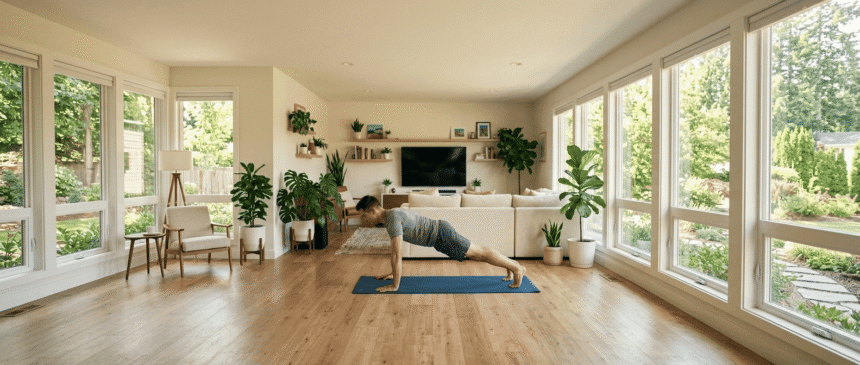
Starting a fitness routine can feel overwhelming, especially if gym memberships, crowded classes, or expensive equipment make the whole idea seem out of reach. The good news is that a home workout for beginners can be just as effective as any gym session, and you can start today with nothing more than a bit of floor space and your own body weight.
In this guide, you’ll find a complete beginner-friendly routine built entirely around bodyweight exercises no equipment required, a ready-to-follow 30-minute home workout plan, a week-by-week progression path, and a breakdown of the most common beginner workout mistakes so you can avoid setbacks and build a habit that actually sticks.
Why a Home Workout Is a Great Starting Point
You don’t need a gym to get stronger, improve your cardiovascular health, or build a lasting exercise habit. Research consistently shows that bodyweight training can produce strength and endurance gains comparable to traditional gym-based training, particularly when you’re just starting out. For beginners, home workouts remove the two biggest barriers to consistency: cost and convenience. There’s no commute, no waiting for equipment, and no intimidation factor. You simply roll out a mat and get moving.
Home training is also flexible in a way gyms often aren’t. You can train first thing in the morning before the day gets busy, squeeze in a session on a lunch break, or break your workout into two shorter blocks if a full 30 minutes doesn’t fit your schedule. That flexibility is one of the biggest reasons beginners who start at home stick with exercise longer than those who rely solely on a gym schedule.
Bodyweight Exercises With No Equipment Needed
The foundation of any beginner routine is a handful of simple, effective moves that work your major muscle groups. Master these first, and you’ll have everything you need for months of progress.
Lower Body
- Bodyweight Squats – Stand with feet shoulder-width apart, lower your hips as if sitting into a chair, then stand back up. Targets your quads, glutes, and hamstrings.
- Glute Bridges – Lie on your back with knees bent, feet flat, and lift your hips toward the ceiling. Great for glutes and lower back strength.
- Walking Lunges – Step forward, lower your back knee toward the floor, then push through your front foot to stand. Builds balance and single-leg strength.
- Calf Raises – Rise onto your toes and lower back down slowly. Strengthens the lower legs and improves ankle stability.
Upper Body
- Push-Ups – Start on your knees if a full push-up is too difficult, and progress to full push-ups over time. Works your chest, shoulders, and triceps.
- Tricep Dips – Using a sturdy chair or the edge of a couch, lower and raise your body using your arms.
- Plank-to-Shoulder Taps – Hold a plank and alternate tapping opposite shoulders. Builds shoulder stability and core control at the same time.
- Superman Holds – Lie face down and lift your arms, chest, and legs slightly off the floor. Strengthens the muscles along your spine that support good posture.
Core
- Plank – Hold a straight-line position on your forearms and toes. Start with 20–30 seconds and build up.
- Reverse Crunches – Lie on your back and bring your knees toward your chest, lifting your hips slightly off the floor.
- Mountain Climbers – From a plank position, drive your knees toward your chest one at a time at a controlled pace.
- Bird Dogs – From all fours, extend one arm and the opposite leg at the same time, keeping your core braced. Excellent for core stability and balance.
You don’t need to do every single exercise every day. Pick 5–6 moves that cover your lower body, upper body, and core, and rotate through them across the week. If you’re also thinking about your overall goals around body composition, pairing this routine with a look at high protein foods for weight loss can help your muscles recover faster between sessions.
A 30-Minute Home Workout Plan for Beginners
Here’s a simple, structured 30-minute home workout plan you can follow two to three times a week. It’s built in three phases so your body warms up properly and cools down safely.
Warm-Up (5 minutes)
- Marching in place – 1 minute
- Arm circles – 1 minute
- Bodyweight squats (slow, controlled) – 1 minute
- Standing torso twists – 1 minute
- Light jumping jacks – 1 minute
Main Circuit (20 minutes)
Perform each exercise for 40 seconds, followed by 20 seconds of rest. Complete the full circuit, rest for 1–2 minutes, then repeat it two more times.
- Bodyweight squats
- Knee or full push-ups
- Glute bridges
- Plank hold
- Walking lunges
- Mountain climbers
Cool-Down (5 minutes)
- Standing quad stretch – 30 seconds per side
- Seated hamstring stretch – 30 seconds per side
- Chest and shoulder stretch – 1 minute
- Deep breathing and relaxation – 2 minutes
If three full rounds feel like too much when you’re just starting, do two rounds instead and build up as your fitness improves. Progress, not perfection, is the goal.
Your First 4 Weeks: A Beginner Progression Plan
One of the biggest questions beginners have is what to actually do once the first workout feels easy. Here’s a simple month-long progression that builds on the 30-minute plan above without needing any new equipment.
Week 1: Learn the Movements
Focus purely on form. Complete two rounds of the main circuit instead of three, and don’t worry about speed. The goal this week is comfort with each exercise, not intensity.
Week 2: Add Volume
Move up to the full three rounds of the circuit. Keep the same 40 seconds work, 20 seconds rest structure, but pay attention to how much more controlled your movement feels compared to week one.
Week 3: Increase Time Under Tension
Extend your work intervals to 45–50 seconds while keeping rest at 20 seconds. This small change increases how long your muscles are working, which builds additional strength and endurance without adding new exercises.
Week 4: Introduce Harder Variations
Swap knee push-ups for full push-ups if you haven’t already, add a slight pause at the bottom of your squats, or extend your plank holds by 10–15 seconds. This is also a good point to consider adding light dumbbells or resistance bands if you want to keep progressing beyond bodyweight alone — a natural next step covered in our guide to strength training for weight loss.
Modifying Exercises for Your Fitness Level
Not every beginner starts at the same place, and that’s completely normal. Use these adjustments to make the routine fit you rather than the other way around.
- If squats are hard on your knees: Reduce your range of motion and only lower halfway, gradually working toward a full squat as strength improves.
- If push-ups feel too difficult: Perform them against a wall or an elevated surface like a countertop before progressing to knee push-ups and then full push-ups.
- If planks cause lower back discomfort: Shorten the hold time and focus on tucking your hips slightly to keep your spine neutral.
- If you want more of a challenge: Add a fourth round to the circuit, reduce rest time to 15 seconds, or hold a light household object (like a filled water bottle) during upper body moves.
Common Beginner Workout Mistakes to Avoid
Most people don’t fail at home workouts because the exercises are too hard — they fail because of a few avoidable habits. Watch out for these common beginner workout mistakes:
- Skipping the warm-up. Jumping straight into intense movement increases your risk of strain or injury. Always spend at least five minutes preparing your body.
- Doing too much, too soon. Going all-out in your first week often leads to burnout or soreness that makes you skip the next session. Build intensity gradually.
- Poor form over more reps. Rushing through squats or push-ups with bad technique reduces results and raises injury risk. Slow down and focus on control.
- Inconsistent scheduling. Working out only when you “feel like it” makes progress unpredictable. Pick set days and treat them like appointments.
- Ignoring recovery. Muscles grow and adapt during rest, not just during exercise. Leave at least one rest day between intense sessions when you’re new to training.
- Comparing yourself to others. Your only real competition is the version of yourself from last week. Track your own progress instead of measuring against social media fitness accounts.
- Training on an empty tank. Trying to push through a hard circuit without eating anything beforehand, or without enough sleep the night before, makes every exercise feel harder than it needs to.
Safety Tips to Prevent Injury
Bodyweight training is generally low-risk, but a few habits go a long way toward keeping you injury-free as you build consistency:
- Always warm up, even on days when you’re short on time — a rushed 2-minute warm-up is still better than none.
- Keep your movements controlled rather than fast and jerky, especially in your first few weeks.
- Stop and rest if you feel sharp pain (different from normal muscle fatigue). Sharp or joint pain is a signal to modify the exercise, not push through it.
- Stay hydrated before and after your session, particularly if you’re training in a warm room.
- Give yourself at least one full rest day between higher-intensity sessions while your body adapts.
Tips to Stay Consistent
Consistency matters more than intensity, especially in the first few months. A few habits that make it easier to stick with a home workout routine:
- Schedule workouts at the same time each day so they become automatic.
- Keep a simple log of your sets, reps, or how each session felt.
- Set up a small, dedicated workout space so you’re not setting up from scratch every time.
- Give yourself credit for shorter sessions on busy days rather than skipping entirely.
- Pair movement with nutrition. If your goal includes weight management alongside general fitness, it’s worth reviewing how eating patterns like intermittent fasting for beginners might fit into your routine.
Do You Eventually Need to Join a Gym?
Not necessarily. Many people build and maintain excellent strength and fitness levels using nothing but bodyweight training, especially once they learn how to increase difficulty through tempo changes, added reps, and reduced rest periods. That said, a gym can offer benefits that are harder to replicate at home, like access to heavier resistance for advanced strength goals, specialized machines, or the accountability of a class environment. The right approach depends on your goals: if you’re mainly focused on general health, weight management, and functional strength, a well-structured home routine can take you a long way on its own. If you eventually want to build significant muscle mass or train for a specific sport, a gym setup with progressive resistance becomes more valuable. Either way, starting at home removes the initial barrier to entry and lets you build the exercise habit first — the equipment can always come later.
Frequently Asked Questions
Can I really get fit with a home workout and no equipment?
Yes. Bodyweight training can build meaningful strength, endurance, and cardiovascular fitness, particularly for beginners whose bodies are still adapting to regular exercise.
How many days a week should a beginner work out at home?
Two to three sessions per week is a solid starting point, with rest days in between to allow your muscles to recover and adapt.
How long until I see results?
Most beginners notice improvements in energy and stamina within two to three weeks, with visible strength and body composition changes typically showing up after 6–8 weeks of consistent training.
What if I miss a few days of my routine?
Missing a day or two won’t undo your progress. Simply pick back up with your next scheduled session rather than trying to “make up” for lost time with an extra-hard workout.
Should I combine bodyweight training with weights eventually?
Once bodyweight exercises start to feel easy, adding light dumbbells or resistance bands is a natural next step for continued progress, especially if your goals include fat loss alongside strength.
Final Thoughts
You don’t need a gym membership or a garage full of equipment to build real strength and fitness. With a simple set of bodyweight exercises, a structured 30-minute routine, a clear month-long progression, and awareness of the common mistakes that trip up most beginners, you have everything you need to start today. Pick a time, clear a small space, and get moving — consistency will do the rest.