

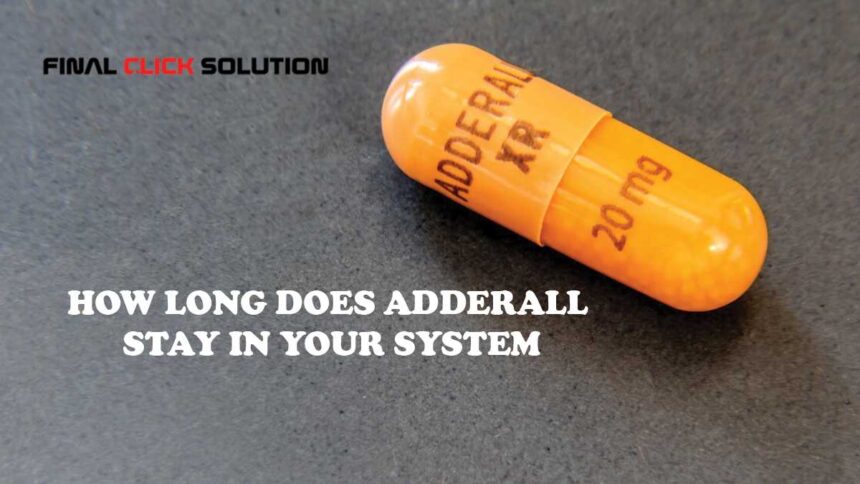
If you have ever taken a prescription stimulant or are preparing for a medical or drug screening, you might wonder how long does adderall stay in your system. It is a common question, and honestly, I asked the same thing years ago when a friend of mine started taking it for focus during university finals. At the time, none of us really understood how medications worked inside the body. We just assumed once the effect wore off, the drug was gone. That assumption turned out to be far from accurate.
The truth is that Adderall can remain in your body longer than you might expect. While its noticeable effects may fade within several hours, traces of the medication can stay detectable in blood, urine, saliva, and hair for varying periods. Understanding this process is helpful for people taking the medication legally, preparing for a drug test, or simply curious about how the body metabolizes stimulants.
In this guide, we will explore the science behind Adderall metabolism, detection timelines, and factors that influence how long it remains in the body. Along the way, I will also share practical insights and real life observations that make the information easier to understand.
What Is Adderall and How Does It Work
Before diving deeper into how long does adderall stay in your system, it helps to understand what the medication actually is.
Adderall is a prescription stimulant made from a combination of amphetamine salts. Doctors commonly prescribe it for conditions such as attention deficit hyperactivity disorder and narcolepsy. The medication works by increasing certain neurotransmitters in the brain, especially dopamine and norepinephrine. These chemicals improve focus, alertness, and energy levels.
When my cousin was first prescribed Adderall during college, he described the experience as suddenly having a clear mental path instead of a cluttered hallway of thoughts. Tasks that once felt overwhelming became manageable.
However, the body does not keep these substances forever. After the drug is absorbed into the bloodstream, the liver metabolizes it and the kidneys gradually eliminate it through urine.
This is where the concept of detection time comes into play.
Why People Ask How Long Does Adderall Stay in Your System
The question how long does adderall stay in your system usually comes up for several practical reasons.
Some people want to know how long the medication will affect their concentration and sleep. Others may be preparing for employment drug screenings or medical tests. Athletes sometimes ask the question as well because stimulant medications are regulated in competitive sports.
In casual conversations I have had with students and professionals, the curiosity often starts with something simple. Someone takes a dose in the afternoon and later wonders why they cannot fall asleep that night. That leads to the realization that the medication may still be circulating in the body long after the initial boost of energy fades.
Average Half Life of Adderall in the Body
One of the most important scientific concepts related to how long does adderall stay in your system is the drug’s half life.
The half life of a medication refers to the amount of time it takes for half of the drug to leave the bloodstream. For Adderall, the half life generally ranges between 9 and 14 hours depending on the person and the formulation.
This means that if a person takes a dose in the morning, roughly half of it may still remain in the body by the evening. Another half will disappear over the next several hours.
A simple analogy I often use is melting ice. Imagine placing a large cube of ice in a bowl. Over time it slowly shrinks. It does not vanish instantly, and even after it becomes small, traces of water remain. Medications behave in a similar way as they gradually break down and exit the body.
Because of this gradual process, complete elimination can take several days.
How Long Does Adderall Stay in Your System for Drug Tests
Now let us answer the question more directly. How long does adderall stay in your system when it comes to different types of drug tests?
Detection times vary depending on the test method.
Urine Tests
Urine testing is the most common form used by employers and clinics.
Adderall can typically be detected in urine for two to four days after the last dose. In some individuals with slower metabolism, it may last slightly longer.
Blood Tests
Blood tests have a shorter detection window.
Adderall usually remains detectable in blood for about 24 hours after use. Because blood testing is more invasive and expensive, it is less commonly used outside medical settings.
Saliva Tests
Saliva tests are increasingly used in roadside drug screening.
The medication may appear in saliva for approximately 20 to 50 hours after taking it.
Hair Tests
Hair testing has the longest detection window.
Traces of amphetamine compounds can remain in hair for up to 90 days. This happens because small amounts of the drug become embedded in hair follicles as they grow.
Factors That Influence How Long Adderall Stays in the Body
Even though general timelines exist, the answer to how long does adderall stay in your system can vary widely from one person to another.
Several factors influence how quickly the body processes the medication.
Metabolism Rate
People with faster metabolic rates tend to break down drugs more quickly. Younger individuals or those with active lifestyles often metabolize stimulants faster.
Body Composition
Body mass and fat distribution can influence drug storage and elimination. Although Adderall is water soluble, body composition still plays a role in circulation and metabolism.
Dosage and Frequency
Higher doses naturally take longer for the body to process. Extended use over several days can also cause small amounts of the drug to accumulate.
Liver and Kidney Function
The liver metabolizes amphetamine compounds while the kidneys remove them from the body. If either organ works more slowly, elimination may take longer.
Urine pH Levels
Interestingly, the acidity of urine can affect how quickly Adderall leaves the body. More acidic urine can accelerate excretion of amphetamines.
I once spoke with a pharmacist who compared this to adjusting the speed of a drain. The same amount of water might take longer or shorter to leave depending on how wide the drain opening is.
Immediate Release vs Extended Release Adderall
Another important detail when discussing how long does adderall stay in your system is the difference between formulations.
There are two main types of Adderall.
Immediate release versions begin working quickly and typically last around four to six hours.
Extended release capsules are designed to release the medication gradually throughout the day, often lasting up to twelve hours.
Even though the extended version lasts longer in terms of effects, the total elimination time from the body is fairly similar. However, extended release formulations may remain detectable slightly longer because of the slower absorption process.
Effects Timeline After Taking Adderall
To better understand the process behind how long does adderall stay in your system, it helps to look at the typical timeline after a dose.
30 to 60 minutes
The medication begins entering the bloodstream and the user may start feeling more alert.
2 to 4 hours
Peak concentration occurs. Focus and energy levels are usually strongest.
6 to 8 hours
The main effects begin to decline, especially with immediate release formulations.
12 hours or more
The body continues metabolizing the drug even though noticeable effects may have faded.
This delayed elimination is the reason some people experience sleep disturbances if they take the medication later in the day.
Personal Observations About Stimulant Duration
I remember a conversation with a coworker who took Adderall during demanding work projects. He once told me he made the mistake of taking a dose around five in the evening because he wanted to finish a report.
The result was not what he expected.
Even though his productivity skyrocketed for a few hours, he ended up staring at the ceiling at two in the morning wondering why sleep would not come. That moment made him curious about stimulant metabolism, and it led to the same question many people ask today.
How long does adderall stay in your system is not just a scientific question. It becomes a very practical one when daily routines, sleep schedules, and work productivity are involved.
Can You Speed Up the Elimination Process
A common follow up question after learning how long does adderall stay in your system is whether the body can eliminate it faster.
The honest answer is that there is no safe or reliable method to dramatically speed up the process. The body will naturally metabolize and remove the drug at its own pace.
However, maintaining healthy habits can support normal metabolism.
Drinking adequate water helps the kidneys function properly. Balanced nutrition supports liver activity. Regular sleep and physical activity can also contribute to a healthy metabolic rate.
Still, none of these approaches act as instant solutions. The safest approach is simply allowing the body enough time to process the medication naturally.
When to Speak With a Doctor
Understanding how long does adderall stay in your system is useful, but it should never replace professional medical advice.
Anyone taking Adderall regularly should follow their doctor’s instructions regarding dosage and timing. If side effects such as insomnia, rapid heartbeat, or anxiety occur, discussing them with a healthcare provider is important.
Medical professionals can adjust dosage or recommend alternative treatments if necessary.
Final Thoughts
The question how long does adderall stay in your system has a layered answer. While the noticeable effects of the medication may last only several hours, the drug itself can remain detectable in the body for days depending on the test type and individual factors.
Urine tests may detect it for several days, blood tests usually within a day, saliva tests up to about two days, and hair tests for months. Metabolism, dosage, health, and formulation all influence these timelines.
Understanding how medications move through the body can feel a bit like learning the rhythm of a clock. Each system has its own pace, and once you recognize that rhythm, the process becomes much easier to understand.
Whether you are taking Adderall for medical reasons, preparing for a screening, or simply exploring how stimulants affect the body, knowledge about detection times can help you make more informed decisions.
And sometimes, as I learned from watching friends navigate college life and busy careers, asking simple questions about how our bodies work can lead to surprisingly fascinating discoveries.