
Let me tell you something that might sound familiar. I stood in front of my bathroom mirror five years ago, flexing as hard as I could, and honestly, nothing much happened. I was that guy who could eat an entire pizza and still look like a strong wind might blow me away. My friends called me “string bean” and while I laughed it off, deep down, I wanted to build some serious muscle.
That’s when I started my journey into the world of supplements for muscle growth, and trust me, it was overwhelming at first. The supplement aisle looked like a science lab exploded, with bottles promising everything from “instant gains” to “superhuman strength.” I made plenty of mistakes, wasted money on garbage products, and learned some hard lessons along the way.
But here’s the good news: I figured it out. And today, I’m going to share everything I’ve learned about supplements that actually work for building muscle, without the marketing fluff or bro-science nonsense.
Why I Started Looking Into Muscle Building Supplements
Before we dive into the specific supplements, let me paint you a picture of where I started. I was hitting the gym four times a week, eating what I thought was enough protein, and following workout programs from YouTube. Six months in, my progress was… minimal. Sure, I felt stronger, but the mirror wasn’t showing much change.
My turning point came when my gym buddy, Marcus, who had transformed from average to absolutely jacked in about a year, sat me down and had a real talk with me. He wasn’t on steroids or anything crazy. He just understood nutrition and supplementation way better than I did. That conversation changed everything.
Understanding What Your Muscles Actually Need to Grow
Here’s something most people don’t realize: building muscle isn’t just about lifting heavy things. Your muscles are like a construction site, and just showing up with a hammer isn’t enough. You need the raw materials too.
When you lift weights, you’re actually creating tiny tears in your muscle fibers. Sounds bad, right? But it’s not. This is how muscles grow. Your body repairs those tears, making the fibers slightly bigger and stronger than before. But here’s the catch: without proper nutrition and the right supplements, your body struggles to complete this repair process efficiently.
Think of it like trying to build a house. You can have the best construction crew in the world, but without enough bricks, wood, and cement, that house isn’t getting built anytime soon.
The Foundational Supplements for Muscle Growth That Changed My Life
Protein Powder: The Non-Negotiable Building Block
I’ll never forget the first time someone explained protein to me properly. It was like a lightbulb moment. Protein is made up of amino acids, which are literally the building blocks of muscle tissue. Without enough protein, you’re basically asking your body to build muscle out of thin air.
When I started tracking my protein intake, I realized I was eating maybe 60 grams a day. For someone trying to build muscle at 165 pounds, I needed closer to 150 grams. That’s a massive gap, and food alone made it really challenging to hit that target consistently.
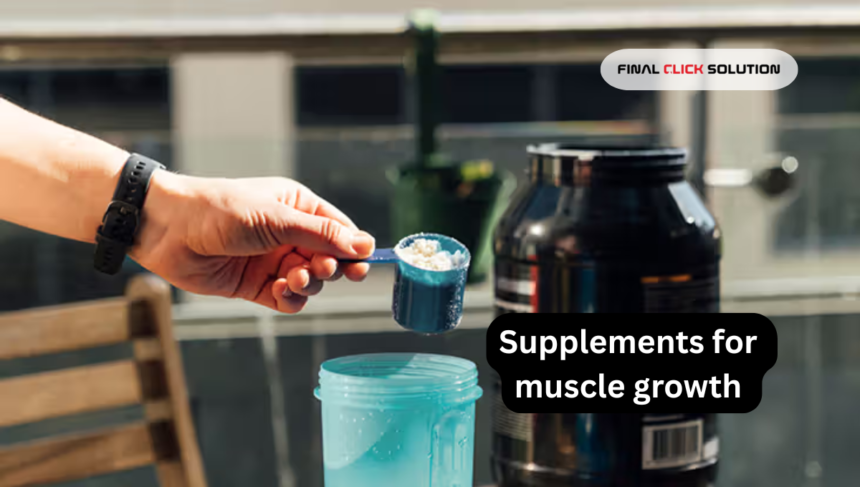
Enter protein powder. This stuff became my secret weapon. I went with whey protein isolate because it digests quickly and has a complete amino acid profile. My post-workout shake became sacred: one scoop of protein powder, a banana, some peanut butter, and almond milk. Simple, effective, and actually pretty delicious.
The results? Within three weeks of consistently hitting my protein targets with the help of protein powder, I noticed my recovery improving dramatically. Muscles that used to be sore for three days were bouncing back in one or two. That meant I could train harder and more frequently.
Creatine Monohydrate: The Most Researched Supplement That Actually Works
If there’s one supplement that has more scientific backing than almost anything else, it’s creatine monohydrate. And yet, I avoided it for months because I heard it would make me bloated or that it was “basically steroids.” Both completely wrong, by the way.
Creatine works by increasing your muscles’ phosphocreatine stores. In simple terms, it helps your muscles produce more energy during high-intensity exercise. Translation: you can push out an extra rep or two, lift slightly heavier weight, and recover faster between sets. Those small improvements add up massively over time.
I started with the standard five grams per day, mixed into my morning water. No loading phase needed, despite what some companies claim. After about three weeks, I noticed I could complete sets that previously destroyed me. My bench press went up by 15 pounds in a month, which might not sound like much, but for someone who had been stuck at the same weight for months, it was incredible.
The slight water retention I experienced was actually intracellular, meaning the water went into my muscles, making them look fuller. Not the puffy, bloated look I was afraid of.
Branched-Chain Amino Acids: My Mid-Workout Game Changer
BCAAs, or branched-chain amino acids, consist of three essential amino acids: leucine, isoleucine, and valine. These are special because your body can’t produce them on its own, so you need to get them through diet or supplementation.
I started using BCAAs during my longer workout sessions, especially on leg days that could stretch to 90 minutes. The difference was noticeable. I felt like I could maintain intensity throughout my entire workout instead of fading halfway through. Plus, my muscle soreness decreased significantly.
Here’s a personal tip: if you’re already consuming enough protein throughout the day and using a good whey protein powder, BCAAs become less critical. But for those early morning fasted workouts or really intense training days, they’re absolutely worth having in your arsenal.
Beta-Alanine: The Tingly Supplement That Extends Your Limits
The first time I took beta-alanine, I thought something was seriously wrong. About 15 minutes after drinking my pre-workout, my face and hands started tingling. It wasn’t painful, just weird. I quickly learned this is called paresthesia, and it’s completely harmless.
Beta-alanine helps buffer lactic acid buildup in your muscles. You know that burning sensation you get during your last few reps? That’s lactic acid. By supplementing with beta-alanine, you can push through a few more reps before that burn becomes unbearable.
For me, this made the biggest difference during high-rep training phases. Sets of 15-20 reps that used to feel impossible became manageable. My muscle endurance improved noticeably over about six weeks of consistent use.
The Supplements I Tried and Honestly Didn’t Need
Let me save you some money and share the supplements that didn’t move the needle for me. Testosterone boosters marketed to natural lifters were mostly useless. Unless you have clinically low testosterone, these herbal blends won’t do much. I wasted probably $200 on various products before accepting this truth.
Mass gainers seemed like a good idea for a skinny guy like me, but they’re basically just expensive sources of calories. You’re better off making your own high-calorie shakes with real food, oats, and protein powder. Plus, many mass gainers are loaded with sugar and cheap fillers.
Pre-made pre-workout blends can be hit or miss. Many contain proprietary blends where you don’t know the exact dosages of each ingredient. I eventually switched to buying individual ingredients and making my own blend. More cost-effective and I knew exactly what I was putting in my body.
Timing Your Supplements for Maximum Muscle Growth
Here’s where things get practical. Having the right supplements is one thing, but timing them properly amplifies their effectiveness significantly.
My current routine looks something like this: I take creatine every morning with breakfast. Timing doesn’t really matter with creatine since it builds up in your system over time, but morning works for consistency. About 30 minutes before my workout, I have a small meal or snack with some caffeine. Post-workout, within 45 minutes, I slam my protein shake. This is when your muscles are most receptive to nutrients, often called the “anabolic window.”
On rest days, I still take my creatine and make sure I’m hitting my protein targets through regular meals and one protein shake. Recovery happens outside the gym, so nutrition on rest days is just as important as training days.
The Mistakes I Made So You Don’t Have To
Looking back, I cringe at some of my early supplementation mistakes. I thought more was better, so I’d double-scoop my protein powder, take creatine twice a day, and basically overdose on every supplement I owned. All that did was waste money and upset my stomach.
Another mistake was expecting supplements to do all the work. I’d take my supplements religiously but half-ass my training and eat junk food regularly. Supplements are exactly what the name implies: supplementary. They enhance an already solid foundation of training and nutrition. They don’t replace it.
I also got caught up in the marketing hype, buying expensive proprietary blends when simple, basic supplements would have worked just as well. The supplement industry makes billions by convincing people they need the latest cutting-edge formula. Most of the time, you don’t.
Real Talk About Natural Muscle Growth Expectations
Setting realistic expectations saved my sanity. As a natural lifter, you’re not going to gain 20 pounds of pure muscle in three months, no matter what supplements you take. If someone claims otherwise, they’re either lying or using something stronger than supplements.
In my first year of proper training with smart supplementation, I gained about 15 pounds of muscle. That might not sound impressive compared to social media transformations, but it was sustainable, natural, and actually stayed on my frame. Year two brought another 8 pounds. The gains slow down over time, and that’s completely normal.
My Current Supplement Stack and Why It Works
Five years into this journey, my supplement routine is surprisingly simple. I use whey protein isolate daily, creatine monohydrate every morning, and occasionally BCAAs during particularly grueling workouts. That’s it. No fancy proprietary blends, no mystery ingredients, just proven supplements that work.
This minimalist approach saves me money and eliminates unnecessary variables. I know exactly how my body responds to each supplement because I introduced them one at a time and tracked the results.
The beauty of this stack is its sustainability. I’m not spending hundreds of dollars monthly on supplements. These basics cost me maybe $50-60 per month, which is totally reasonable considering the value they provide.
The Bottom Line on Building Muscle With Smart Supplementation
Here’s what I wish someone had told me on day one: supplements for muscle growth work, but only when they’re part of a bigger picture. You need consistent training, adequate sleep, proper nutrition, and then supplements to enhance everything else you’re doing right.
Start with the basics: protein powder and creatine. Master your training and diet first. Once those fundamentals are solid, consider adding other supplements based on your specific needs and goals. Don’t get caught up in the hype, and remember that patience and consistency will always beat the latest miracle supplement.
My transformation from string bean to someone who actually looks like they lift didn’t happen overnight, and it didn’t happen because of supplements alone. But the right supplements, used intelligently, accelerated my progress and helped me push past plateaus that might have otherwise discouraged me into quitting.
Your journey will be different from mine, but the principles remain the same. Focus on what actually works, ignore the noise, and stay consistent. The muscle you build through smart training, solid nutrition, and strategic supplementation will be real, sustainable, and something you can genuinely be proud of.